What to Check Before Buying Salt and Pepper Diamond Rings (So You Don't Get Burned)
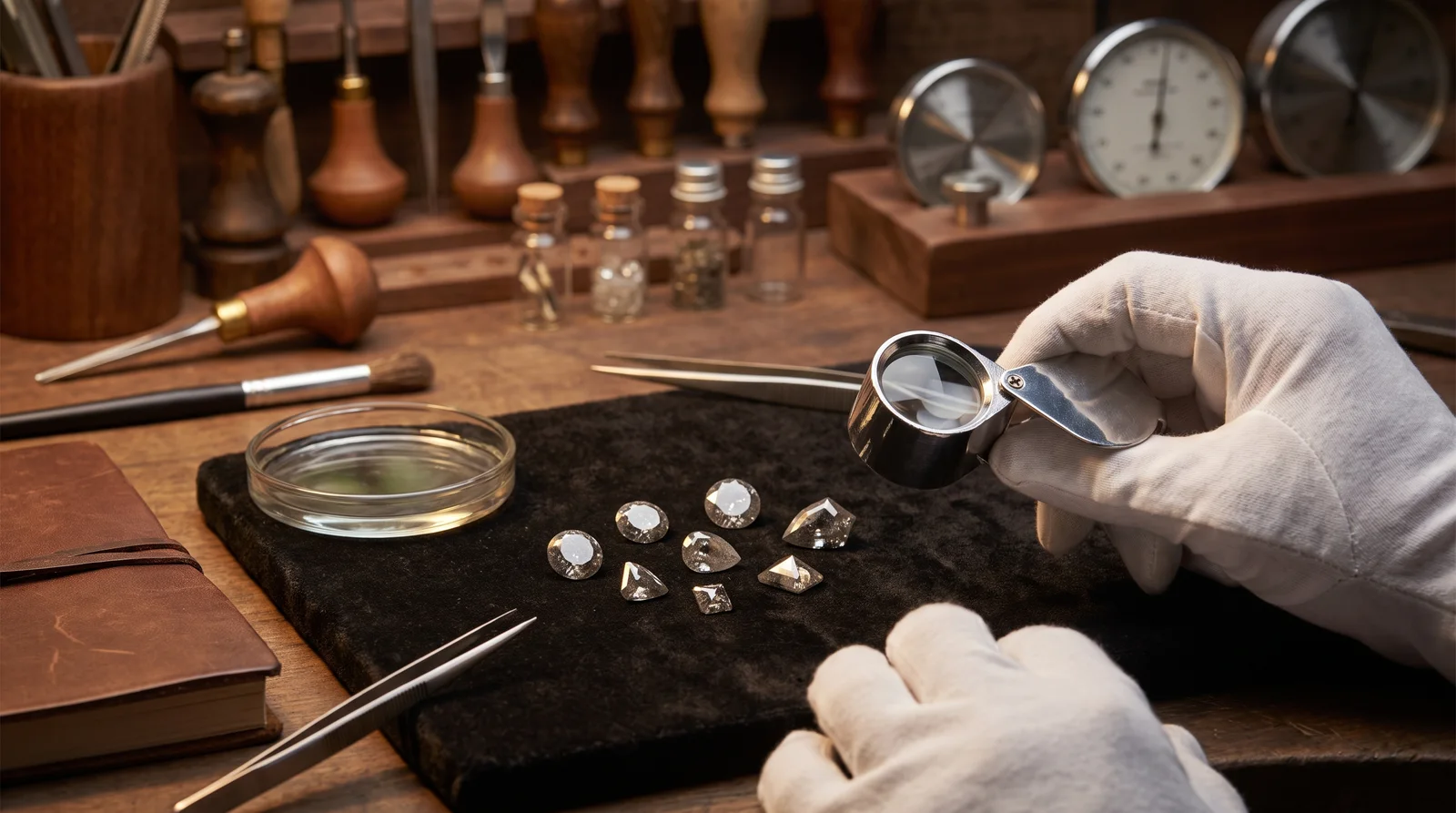
What to check before buying a salt and pepper diamond comes down to three things: how the inclusion pattern looks in person, whether the color has been treated and disclosed, and whether the seller can back up any durability claims with a real report. Standard clarity grades and cut scores barely apply here. Instead, you're judging the stone the way you'd judge a piece of natural art, with treatment disclosure as your non-negotiable check.
Why Salt and Pepper Diamonds Break the Normal Rules
Salt and pepper diamonds don't follow the grading logic that governs a typical white diamond purchase. A conventional stone gets judged on how invisible its flaws are. A salt and pepper stone gets judged on how good those flaws look. That's a real shift in mindset, not just marketing language.
Every diamond forms with some trace minerals and carbon inclusions trapped inside it. In a salt and pepper stone, that trapped material shows up in volume, scattered as black carbon specks, white feathers, or grey clouds. On the GIA scale, nearly every one of these stones lands at I2 or I3, the bottom tier. That number tells you almost nothing useful once you're already shopping this category, because two I3 stones can look completely different from each other.
This is where a checklist matters more than a certificate. You're not asking "what grade is this." You're asking "does this pattern actually work, is the color honest, and will this stone hold up." Let's go through each piece.
Salt and Pepper Diamond Clarity and Inclusions: What You're Actually Looking For
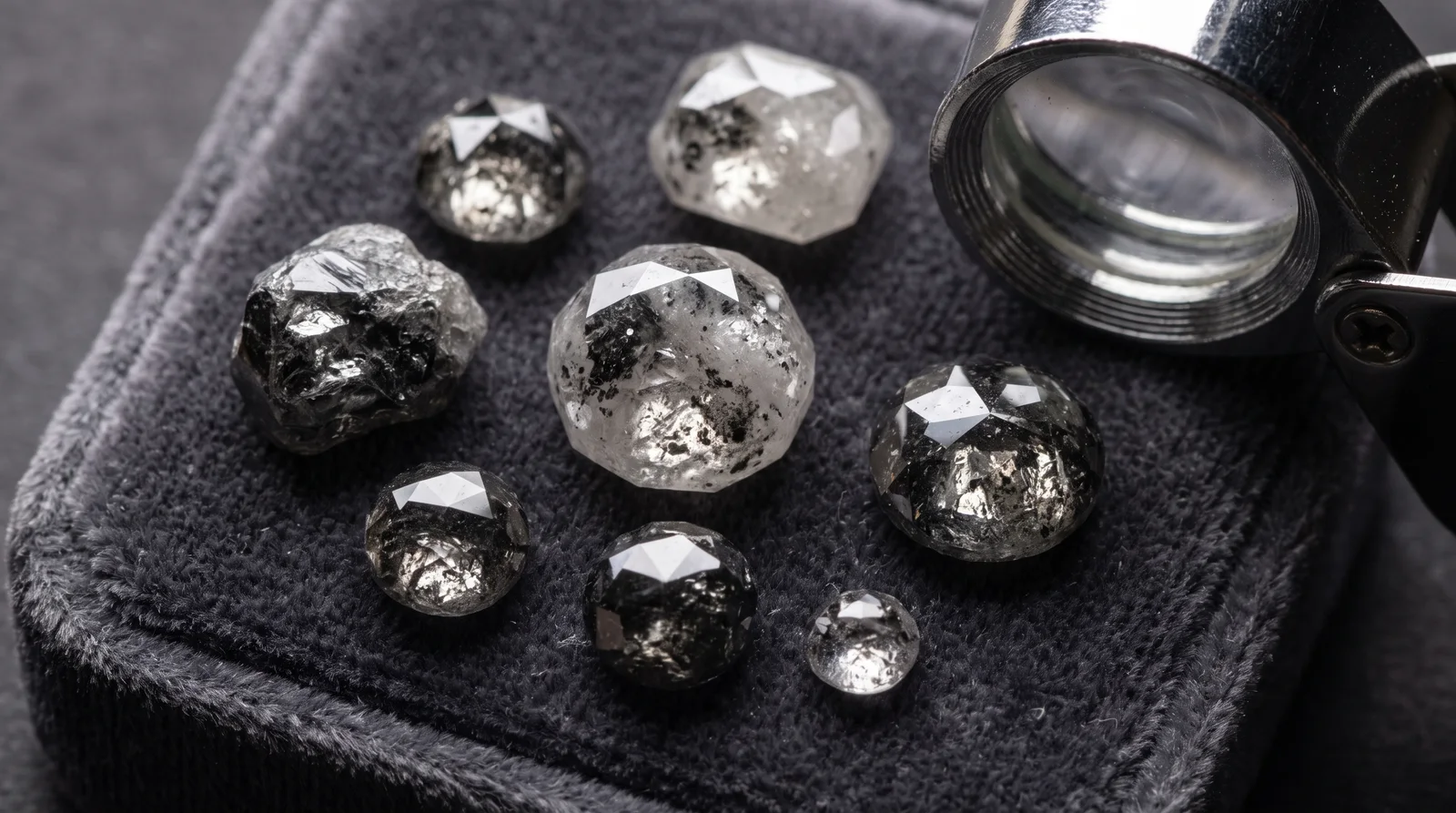
Salt and pepper diamond clarity and inclusions should be evaluated by pattern and placement, not by counting flaws against a scale that wasn't built for this category. Forget the idea that fewer inclusions means better quality here. It's the opposite logic entirely.
Reading the Pattern Instead of the Grade
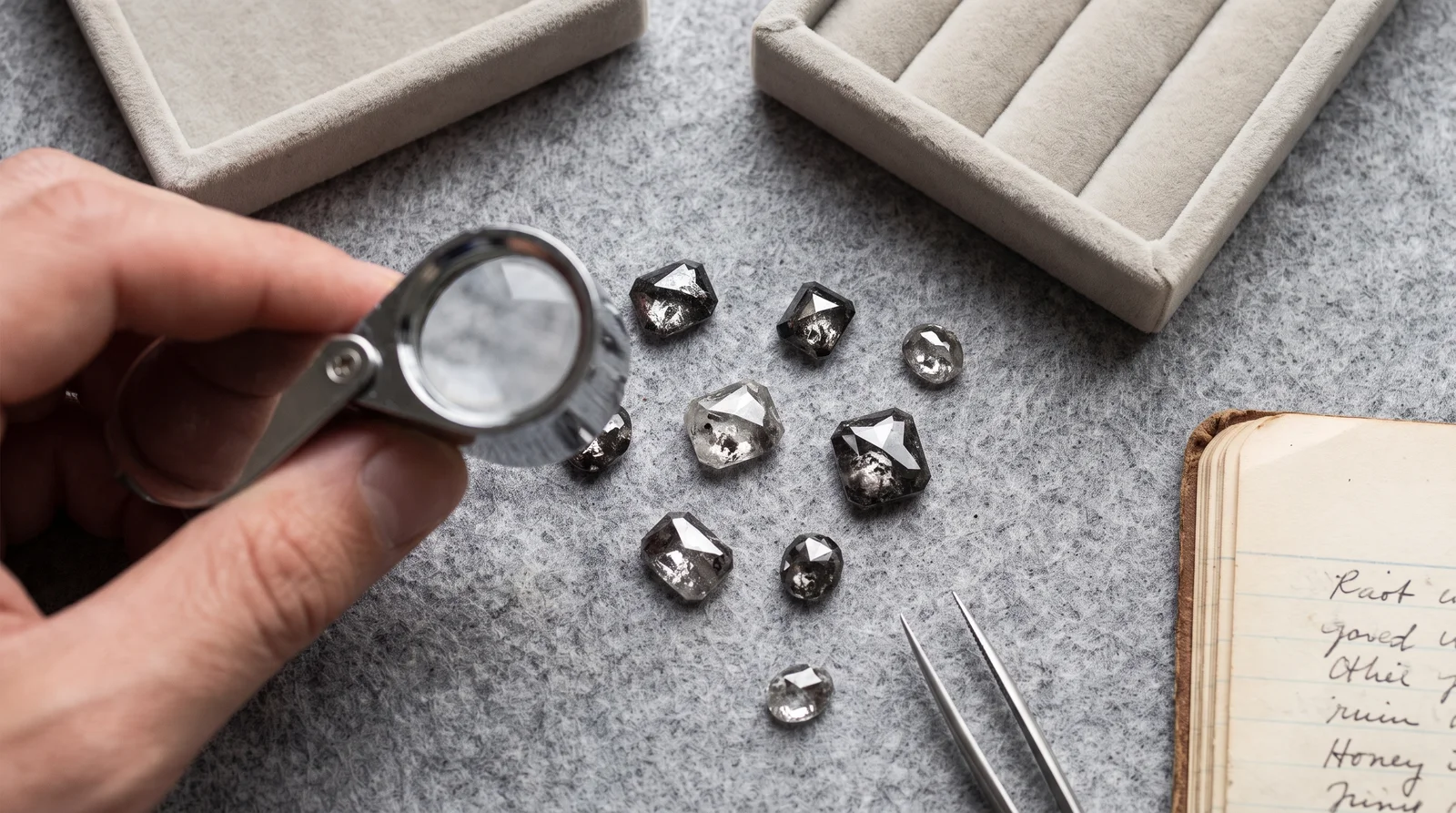
Look at how the black and white inclusions sit against each other. Some stones have a dense, even speckling that reads like a snowstorm caught mid-fall. Others have a single dramatic dark cluster surrounded by lighter pinpoints, sometimes called a beauty mark stone. Neither style is objectively better. It's a personal call, similar to picking a paint splatter you'd want on your wall forever.
Symmetry matters more than density. A stone with inclusions clustered awkwardly to one side can look unbalanced once it's set, even if the total inclusion count is identical to a more evenly distributed stone. Ask to see the diamond loose, under regular indoor light, not just under a jeweler's spotlight designed to make sparkle pop.
Surface-Reaching Inclusions Deserve Extra Scrutiny
Inclusions sitting entirely inside the stone are cosmetic. Inclusions that break the surface are a different story. A feather or fracture that reaches the girdle or table can catch on fabric, trap soap residue, or in rare cases chip under a sharp knock. Ask your jeweler directly whether any inclusions reach the surface, and ask them to show you where under magnification.
This single question separates a jeweler who knows the stone from one just reading off a spec sheet. A good seller will pull out a loupe without hesitation. If they can't answer, or seem annoyed by the question, treat that as a signal worth paying attention to.
Once you've settled on a pattern you like, the next thing to nail down is color, since it works differently here too.
Salt and Pepper Diamond Color Chart Basics You Need Before You Shop
A salt and pepper diamond color chart isn't about the D-to-Z colorless scale used for white diamonds. It's about the overall tone the inclusions create once light passes through the stone, ranging from icy white to charcoal grey to warm champagne. Knowing which category you want narrows your search fast.
Icy, Grey, and Galaxy Tones Explained
Stones with mostly white inclusions, like clouds, pinpoints, or small feathers, read as icy or frosted. They tend to look brighter and more casual. Stones with a heavier mix of black carbon material read greyer, sometimes almost smoky. A near-even mix of black and white creates what a lot of jewelers call a galaxy look, with flecks of color scattered like stars.
Occasionally you'll see a flash of green, orange, or yellow inside a salt and pepper stone. That comes from trace minerals like garnet or pyrite, or in rare cases radiation staining that occurred naturally underground over millions of years. These color flashes are not a treatment. They're part of the stone's original formation and tend to be prized rather than penalized.
Why Color Consistency Still Matters
Even within the salt and pepper category, buyers should still lean toward a base stone that isn't muddy or brownish unless that warmer tone is specifically what they want. A cloudy, low-transparency stone can look flat and lifeless regardless of how interesting its inclusion pattern is. Hold the diamond up to natural window light and check whether it still has some brightness coming through the body of the stone, not just around the inclusions.
Color and pattern go hand in hand, but neither one tells you whether that color is natural. That's where treatment verification comes in, and it's the part most buyers skip.
How to Verify Salt and Pepper Diamond Treatment Before You Pay
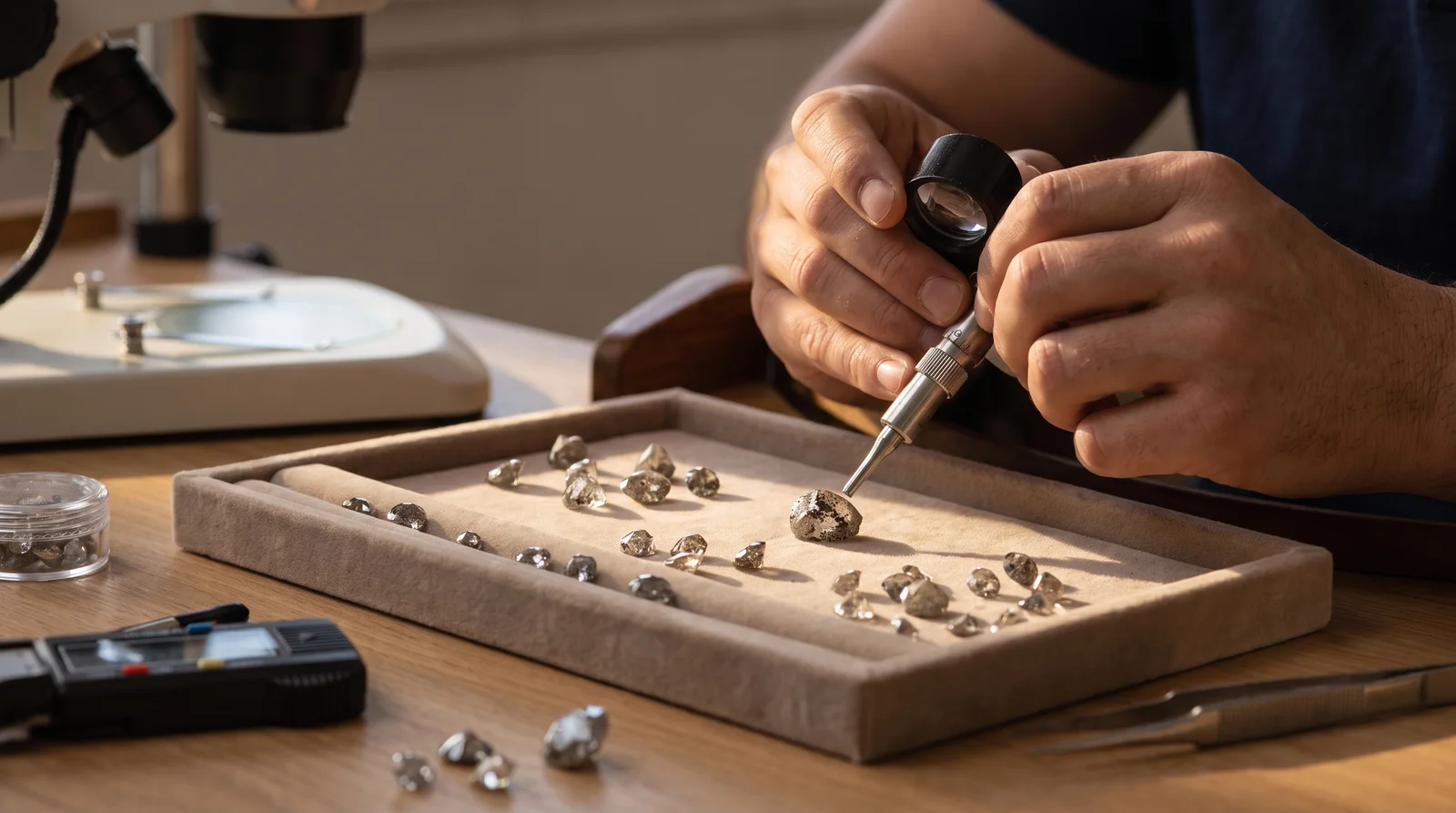
How to verify salt and pepper diamond treatment starts with a direct question to the seller: has this stone been treated, and can you provide documentation. Most salt and pepper diamonds are untreated natural stones, but some in the market have been irradiated or heat treated to intensify color, and disclosure isn't always volunteered.
Ask for the Report Number, Not a Photo of One
A grading report proves identity and quality. It does not automatically prove origin or ethics, but it does confirm whether a stone is natural, lab grown, or treated in a disclosed way. Ask for the actual report number and the lab that issued it, then look that number up directly on the lab's own website. Never rely on a screenshot or PDF sent by the seller, since that document can be edited or can simply belong to a different stone entirely.
This single step catches the overwhelming majority of mismatches in the trade. If the seller hesitates to give you a report number before you've paid, that hesitation is itself useful information. A jeweler with nothing to hide will hand it over without a second thought.
Match the Report to the Physical Stone
Once you have the report, compare its measurements against the actual diamond. Millimeter dimensions on the report should match what you see in photos and in person. Many modern lab-graded stones also carry a laser inscription on the girdle matching the report number. Ask your jeweler to point it out under magnification, or ask them to confirm it in writing if you're buying remotely.
If you want a deeper walkthrough on authentication, our guide on how to tell if a diamond is real at home covers several checks you can run yourself before you ever hand over payment. Treatment verification and authenticity checks work hand in hand, so it's worth doing both.
Once you've confirmed the stone is what the seller claims, durability is the next practical concern, especially since this is a ring you'll presumably wear every day.
Salt and Pepper Diamond Durability and Hardness for Everyday Wear
Salt and pepper diamond durability and hardness sit at a perfect 10 on the Mohs scale, identical to any other diamond, because hardness is a property of the carbon crystal itself, not the inclusions inside it. That said, hardness and toughness are not the same thing, and this distinction matters more here than with a typical white diamond.
Hardness Resists Scratching, Toughness Resists Breaking
Hardness means nothing short of another diamond will scratch the surface. Toughness refers to whether the stone can withstand a sharp knock without chipping or fracturing. A salt and pepper diamond with heavy surface-reaching feathers, particularly near the girdle or a pointed tip on a pear or marquise cut, can be more vulnerable to chipping at that specific spot, even though the material itself is just as hard as any colorless diamond.
This is why the inclusion mapping conversation from earlier isn't just about looks. A jeweler who has actually inspected the stone under magnification can tell you whether its particular inclusion pattern poses any real structural risk, or whether it's purely cosmetic. Ask this question plainly. A reputable seller will not sell a structurally compromised stone, but you should still confirm it yourself rather than assume.
Setting Choice Affects Long-Term Durability Too
A bezel setting that wraps protective metal around the edge of the stone reduces the risk of chipping compared to a delicate prong setting, especially on pointed shapes. If you've chosen a stone with visible surface inclusions near the tip of a pear or marquise cut, ask your jeweler whether a protective setting style makes sense for your lifestyle. This is a small design decision that can meaningfully extend how well the ring holds up over decades of daily wear.
Durability naturally leads into the question everyone eventually asks, which is how all of this affects price compared to a standard white diamond.
Salt and Pepper Diamond vs White Diamond Price: What Drives the Gap
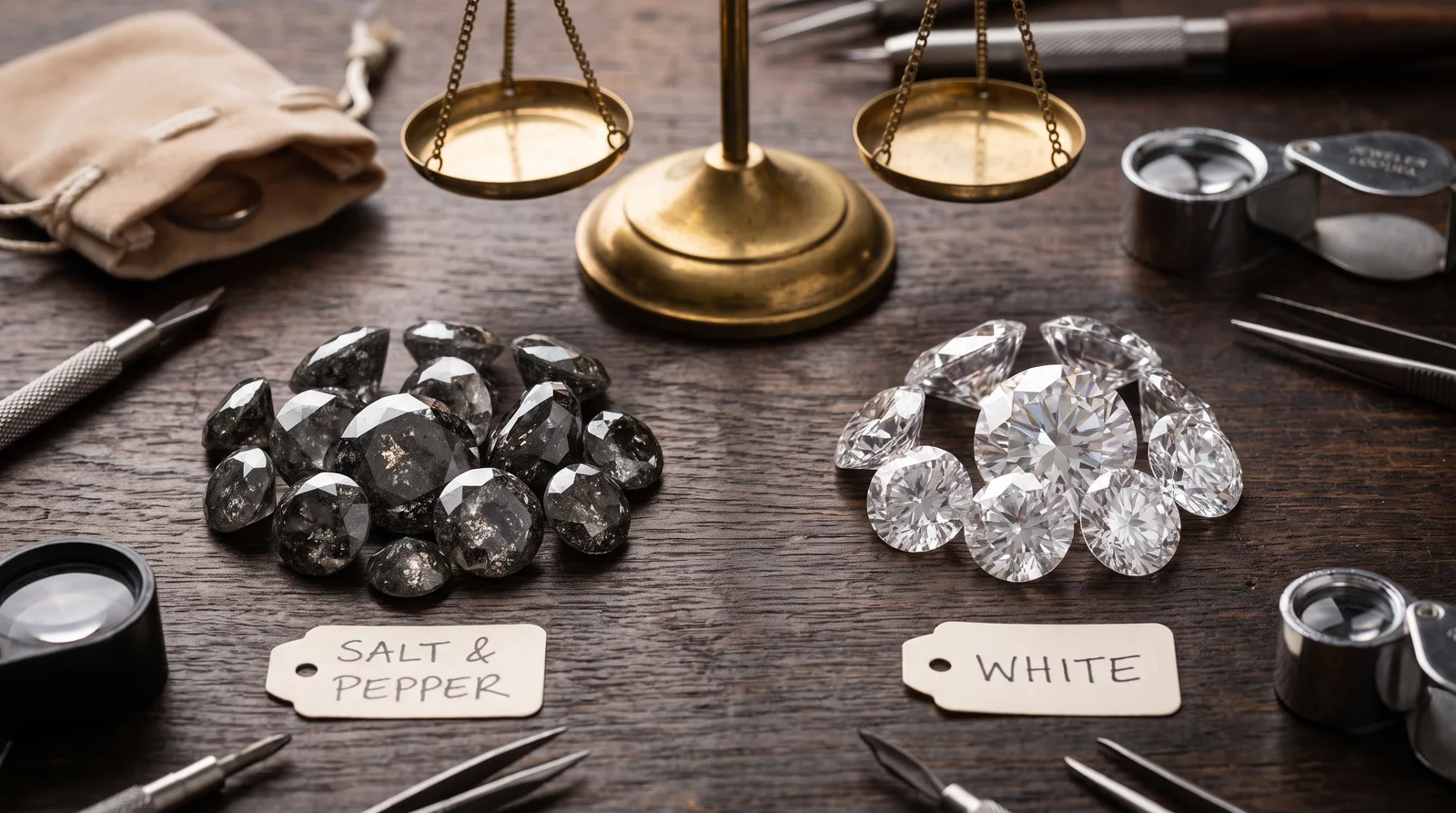
Salt and pepper diamond vs white diamond price comparisons almost always favor the salt and pepper stone, often significantly, because heavy inclusions push these diamonds to the bottom of the traditional clarity scale where demand and pricing have historically been lowest. A colorless, eye-clean white diamond in the VS clarity range command a real premium. A salt and pepper stone of similar carat weight typically costs a fraction of that.
This price gap is genuinely good news for buyers working within a set budget. It means you can often afford a noticeably larger center stone in a salt and pepper diamond than you could in a comparable white diamond, without stretching your spending. Average center stone sizes in this category have actually been trending smaller in recent years, not because prices rose, but because more buyers are prioritizing a striking pattern over sheer carat weight.
Carat and cut still play a role in final pricing, even outside the standard clarity framework. A larger stone with a clean, well-balanced pattern will cost more than a smaller stone with a similar look. A dramatic or rare pattern, like a strong beauty mark surrounded by fine white pinpoints, can also push price up even at a modest carat weight, since pattern rarity functions a bit like color rarity does in colored diamonds.
Price naturally ties back into pattern and contrast, which is really the heart of what makes each of these stones one of a kind.
Salt and Pepper Diamond Pattern and Contrast: The Real Buying Criteria
Salt and pepper diamond pattern and contrast are the two qualities that should guide your final decision more than any other single factor, since they determine how the stone actually reads on the hand. This is the part of the checklist that most closely resembles judging a piece of art rather than reading a spec sheet.
Contrast Creates the Visual Drama
Strong contrast between dark carbon inclusions and lighter feathers or clouds creates a crisp, graphic look that photographs well and catches light in an almost sparkly way. Lower contrast, where the inclusions blend more into a soft grey haze, creates a moodier, more atmospheric effect. Some buyers want the drama of high contrast. Others want the quieter, foggier look. Neither choice is a compromise, since both come from the same underlying stone quality.
Matching Pattern to Cut and Setting
Certain cuts flatter certain patterns. A rose cut, with its flat base and domed crown, tends to showcase inclusions in a soft, painterly way, since light scatters more gently through the stone. A step cut, like an emerald or elongated hexagon shape, shows off pattern with more graphic clarity, almost like looking through a window. Kite and marquise shapes elongate the pattern, which can make a scattered inclusion field look more dynamic across the length of the stone.
If you're still deciding on shape and setting more broadly, our guide on how to choose a diamond for an engagement ring covers the foundational decisions that still apply here, even though clarity grading works differently for this category. Understanding the standard framework actually helps you appreciate exactly where salt and pepper diamonds intentionally diverge from it.
With pattern, contrast, treatment, and durability all covered, a few common questions still come up again and again from first-time buyers.
Frequently Asked Questions About Buying Salt and Pepper Diamonds
How do I know if a salt and pepper diamond's color has been treated?
Ask the seller directly and request a grading report that discloses any treatment history. Untreated natural color is the norm in this category, but occasional stones are irradiated to deepen tone, and that should always be disclosed in writing before purchase.
Why don't salt and pepper diamonds get a normal clarity grade?
They technically can, but nearly every stone lands at the bottom of the scale, I2 or I3, so the letter grade stops being useful. The trade evaluates these stones by pattern, contrast, and transparency instead, since that's what actually varies from one stone to the next.
Can a salt and pepper diamond chip more easily than a white diamond?
Not because of hardness, since both score 10 on the Mohs scale. Risk comes from toughness, specifically whether inclusions reach the surface near a vulnerable point like a pear tip, which is why asking about surface-reaching inclusions matters.
Does a salt and pepper diamond cost less than a white diamond of the same size?
Generally yes, often substantially less, since heavy inclusion density places these stones outside the pricing tiers that reward colorless clarity. This is a major reason the category has grown popular with budget-conscious buyers wanting a larger center stone.
What's the difference between salt and pepper and black diamonds?
Salt and pepper diamonds show a mix of black and white inclusions scattered through a translucent stone. Black diamonds are opaque and appear uniformly dark throughout, since their inclusion density and type is different and more concentrated.
Putting Your Checklist Together
Buying a salt and pepper diamond really comes down to trusting your eye while backing that up with paperwork. Look at the pattern in real light, not just under a jeweler's spotlight. Ask plainly whether the color has been treated. Get a report number and check it yourself on the lab's own site rather than taking a screenshot at face value. Ask about surface-reaching inclusions before you fall in love with a stone that might need a protective setting. None of this takes long, and every step of it protects you from paying full price for a story that doesn't hold up under a loupe. If you're ready to see how these stones look set in an actual ring, reach out and we'll walk through options together, patterns, settings, and all.