How to Tell if a Diamond Is Real at Home (Before You Panic or Call a Jeweler)
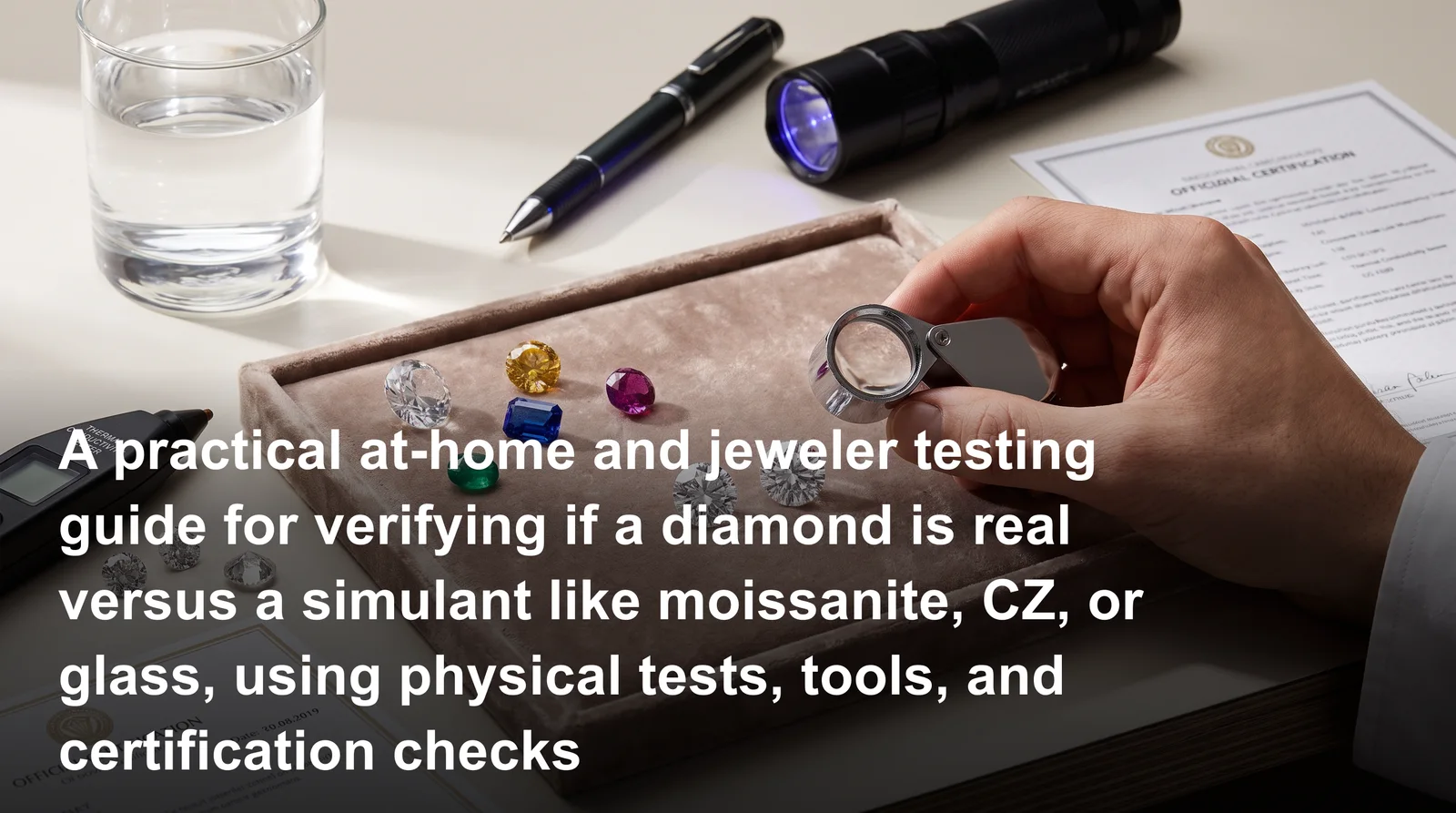
Found a loose stone in a drawer? Inherited a ring you don't trust? You don't need a lab to get a first answer. This guide shows you how to tell if a diamond is real at home with tests you can run right now, plus when to stop guessing and see a pro.
The short answer: no single home test proves a diamond is real. But a few tests run together can get you close. A fog test, a water test, a look under UV light, and a simple read-through check will tell you a lot in under ten minutes.
What You're Actually Trying to Rule Out
Before you test anything, know what you're testing against. Most fake diamonds fall into four groups: cubic zirconia, glass, quartz, and moissanite.
Cubic zirconia is dense and shiny but soft. Glass is light and scratches easily. Quartz looks close at a glance but lacks real fire.
Moissanite is the tricky one. It's a lab-made mineral that passes heat tests almost as well as diamond does. It sparkles more than diamond, not less, which throws people off.
One more thing worth knowing up front. Lab-grown diamonds are chemically real diamonds. None of the tests below can tell a lab-grown stone from a mined one, because they're made of the same carbon crystal. That distinction only shows up on paper, through certification. Keep that in mind as you work through each test.
The Diamond Fog Test You Can Run in Ten Seconds
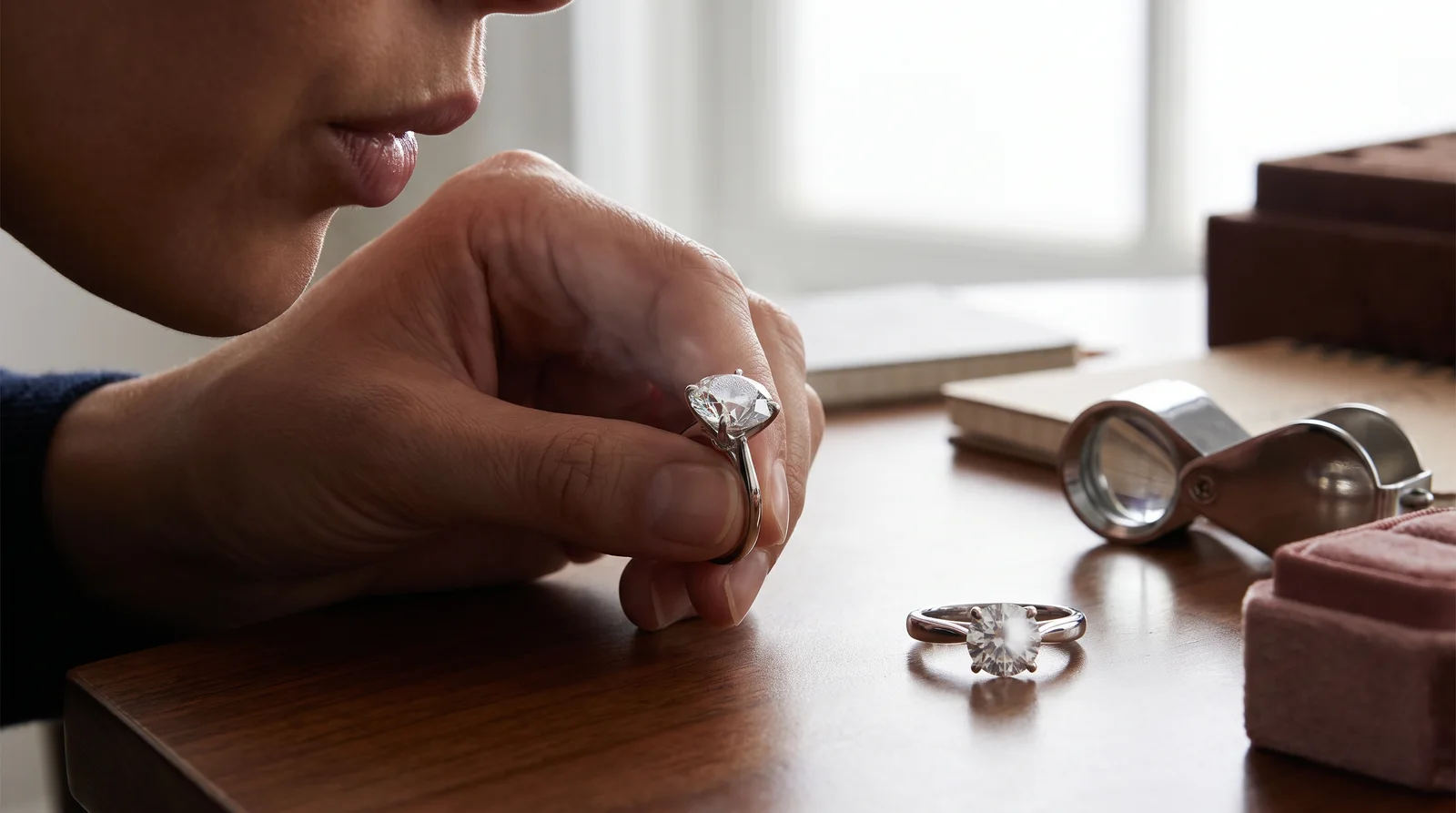
The diamond fog test checks how fast heat leaves the stone's surface. Hold the stone close to your mouth and breathe on it like you're fogging a mirror.
A real diamond clears the fog almost right away, usually in a second or two. Diamonds pull heat away from their surface fast, so condensation can't sit there long.
Cubic zirconia and glass hold onto that fog for three seconds or more. That's your clue something's off.
Here's the catch. Moissanite conducts heat almost as well as diamond does. It clears fast too.
So a quick clear tells you "likely not glass or CZ." It doesn't tell you diamond versus moissanite. Treat this test as a first filter, not a final answer. Next, let's check density with something you already have in your kitchen.
The Diamond Water Test and Why It Fools People
The diamond water test gets shared as solid proof, but it's actually one of the weakest checks you can run. Drop the loose stone into a glass of water and watch what happens.
A real diamond sinks. It's dense, about 3.51 grams per cubic centimeter, so it drops fast.
Here's the problem. Cubic zirconia is even denser, around 5.6 to 6.0 grams per cubic centimeter. It sinks too, often faster than a real diamond.
Moissanite is lighter than diamond, at about 3.22 grams per cubic centimeter. It still sinks. Glass sometimes floats or sinks slowly, but that's about the only useful result this test gives you.
If your stone floats, that's a real red flag. If it sinks, you've learned almost nothing new. This test only rules out low-density fakes like plastic. It won't separate diamond from CZ or moissanite, so don't stop here.
How to Tell if a Diamond Is Real With a Flashlight
Wondering how to tell if a diamond is real with a flashlight? Shine a bright light at the stone and watch how it scatters.
A real diamond throws sharp flashes of white light mixed with small hits of color. Gemologists call that combo brilliance and fire.
Moissanite does something other. It throws way more rainbow color than diamond does, almost like a disco ball.
If your stone looks like it's shooting rainbows in every direction under a flashlight, you might be looking at moissanite, not diamond. Glass and cubic zirconia tend to look flatter under direct light. The sparkle seems more uniform and less sharp.
None of this is exact science. Cut quality changes how any stone reflects light. A poorly cut diamond can look dull, and a well-cut fake can look convincing. Use the flashlight test as one more data point, not a verdict. Now let's talk about a test that actually uses physics in your favor.
The Read-Through Test for Loose Stones
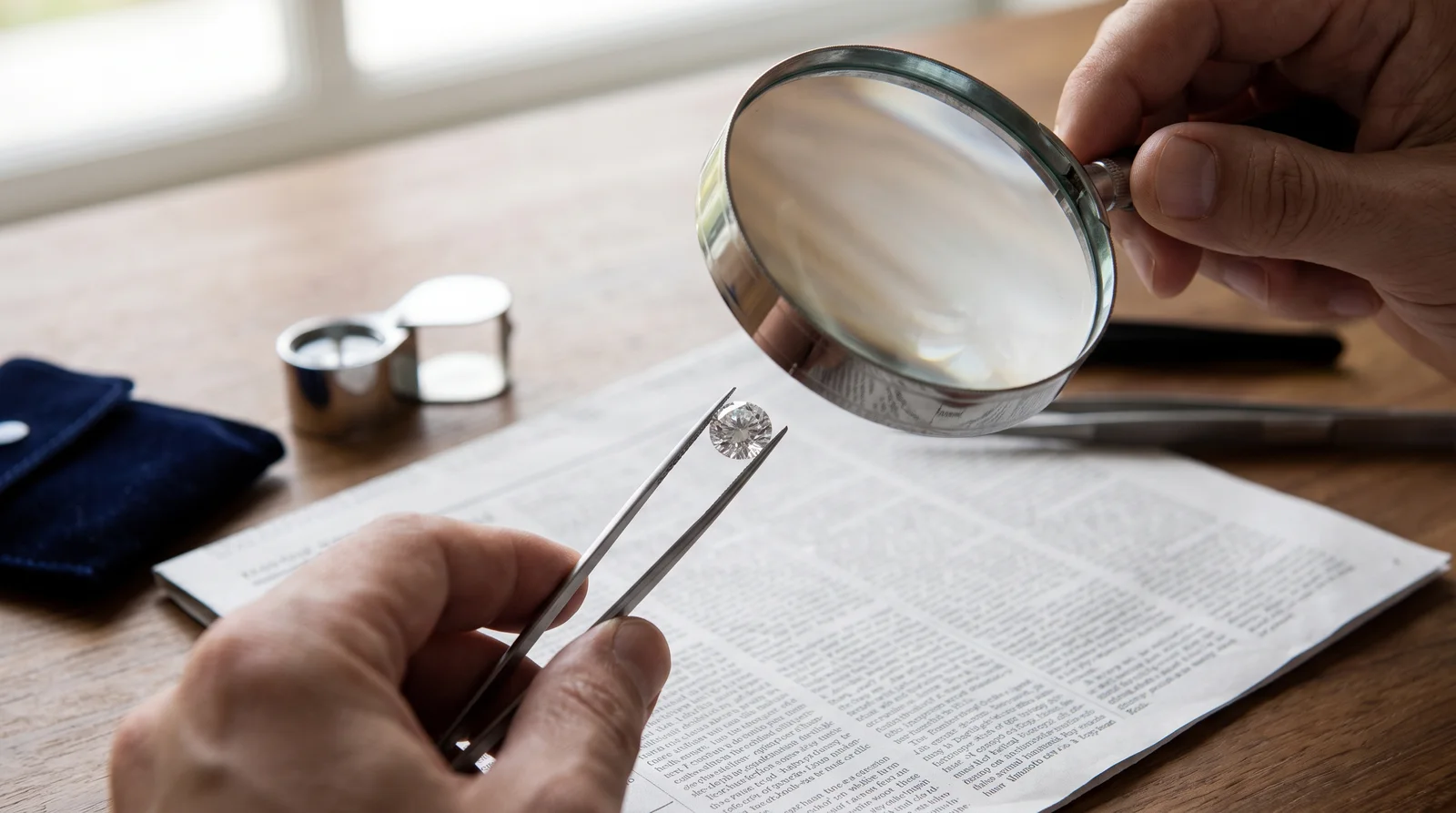
The read-through test, also called the newspaper or dot test, uses a diamond's refractive index against it. This one only works on loose, unmounted stones, so skip it if your diamond is set in a ring.
How to Run the Dot Test
Draw a small dot on a piece of paper. Place the stone flat side down, right over the dot.
Look through the pointed top of the stone. A real diamond bends light so hard that the dot disappears or blurs beyond recognition.
If you can see the dot clearly, you're likely holding cubic zirconia or glass. Those stones don't bend light nearly as much.
Why This Test Still Has Gaps
Moissanite has a high refractive index too, close to diamond's. It hides the dot just as well, which means a blurry result narrows things down to "diamond or moissanite," not a clear win.
Cut angle also matters here. A shallow or poorly cut diamond might let more light through than it should, giving you a false read. Treat this test as useful, but not final. Let's move to a test involving actual light waves instead of light bending.
What a UV Light Reaction Does and Doesn't Prove
A UV light test checks for fluorescence, a glow some diamonds give off under ultraviolet light. Take the stone into a dark room and shine a UV flashlight directly on it.
About a third of natural diamonds show a soft blue glow under UV. That's a real, documented pattern from gemological data.
But here's the gap. Most natural diamonds don't glow at all, so no reaction proves nothing on its own.
Lab-grown diamonds tend to show weaker fluorescence than mined ones, or none. Cubic zirconia sometimes glows faint yellow or white, which can trip people up if they expect only diamonds to react.
Moissanite rarely shows a blue glow like diamond does. If your stone lights up strong blue, that leans toward natural diamond. If it glows yellow, or doesn'thing, you genuinely can't conclude much either way. This test adds a clue, never a final call. Now let's weigh things, literally.
Weighing Your Stone Against Known Standards
Weighing a stone works only when it's loose, and only if you have a scale accurate to 0.01 grams. A one-carat diamond weighs exactly 0.2 grams, so you're checking whether the weight matches the size you'd expect.
Cubic zirconia runs heavier than diamond, often 60 to 70 percent more for the same visual size. A stone that looks like a one-carat diamond but weighs noticeably more is worth a second look.
Moissanite runs lighter than diamond, roughly 10 percent less for a similar size. This test needs a jeweler's scale most people don't own, and it still can't tell mined from lab-grown.
It's a nice confirming detail, not a stand-alone answer. With the easy home checks covered, it's time to talk about tools that actually settle the moissanite question.
Professional Tools That Settle the Moissanite Question
A diamond tester pen is the fastest way to get a real answer, mainly the dual-mode kind. These small handheld devices read how a stone conducts heat, and some models add an electrical reading too.
Why Single-Mode Testers Get Fooled
A basic thermal-only tester reads heat conduction and nothing else. Moissanite conducts heat almost identically to diamond, so a single-mode pen often flags it as diamond by mistake.
That's the most common way people get burned using cheap testers. It's not that the tool is broken. It's just reading the wrong property.
Why Dual Testers Work Better
A dual thermal-and-electrical diamond tester pen checks conductivity two other ways. Diamond and moissanite behave differently on the electrical reading, even though they're close on heat.
These testers usually cost between 60 and 150 dollars. Brands like Presidium and GemOro show up often in jewelry supply stores and online.
To get a clean reading, hold the probe straight up against the stone. Press lightly, and make sure the stone sits at room temperature first.
A stone that just came out of a cold pocket can throw off the result. So can testing the metal setting by accident instead of the stone itself. Once you've got a tester reading, there's still one more layer of confirmation worth getting.
Loupe Inspection and What a Jeweler Actually Looks For
A jeweler's loupe reveals structural details your eyes alone will miss. A basic 10x loupe costs 15 to 40 dollars, and it's worth owning if you handle jewelry often.
Real diamonds get cut with intense precision. Under magnification, their facet edges look razor sharp, and the lines where facets meet stay crisp.
Moissanite gives away a other clue. Because it's doubly refractive, you can sometimes see doubled facet lines on the back of the stone when you look through the top.
Cubic zirconia tends to look too clean. Natural diamonds usually carry small internal marks called inclusions, sort of like a fingerprint. A stone with zero flaws under magnification, mainly at a low price point, deserves more scrutiny.
If you're unsure what you're seeing, that's a normal reaction. Reading facet doubling under a loupe takes practice most people don't have, and that's exactly when a jeweler's trained eye earns its keep. If you suspect moissanite clearly, this guide on lab diamond vs moissanite breaks down the visual differences in more depth. Speaking of jewelers, let's talk about the one document that ends the guesswork entirely.
Diamond Certification GIA IGI and How to Check One
Diamond certification through GIA IGI gives you paperwork that backs up what a trained gemologist actually saw under a microscope. If your stone came with a certificate, you can usually verify it online through the issuing lab's own report lookup tool.
GIA, the Gemological Institute of America, is considered the strictest grading lab in the industry. IGI, the International Gemological Institute, grades a large share of lab-grown diamonds sold today.
Many diamonds also carry a tiny laser inscription on the girdle, the thin edge around the stone. That inscription usually matches a report number you can look up directly.
No certificate doesn't automatically mean the stone's fake. Plenty of older or inherited jewelry was never sent to a lab. But if you're holding paperwork right now, checking the report number is the fastest way to confirm what you have. If you don't have paperwork, that brings us to the real question: when do you stop testing and go see someone?
When to Stop Testing and See a Jeweler
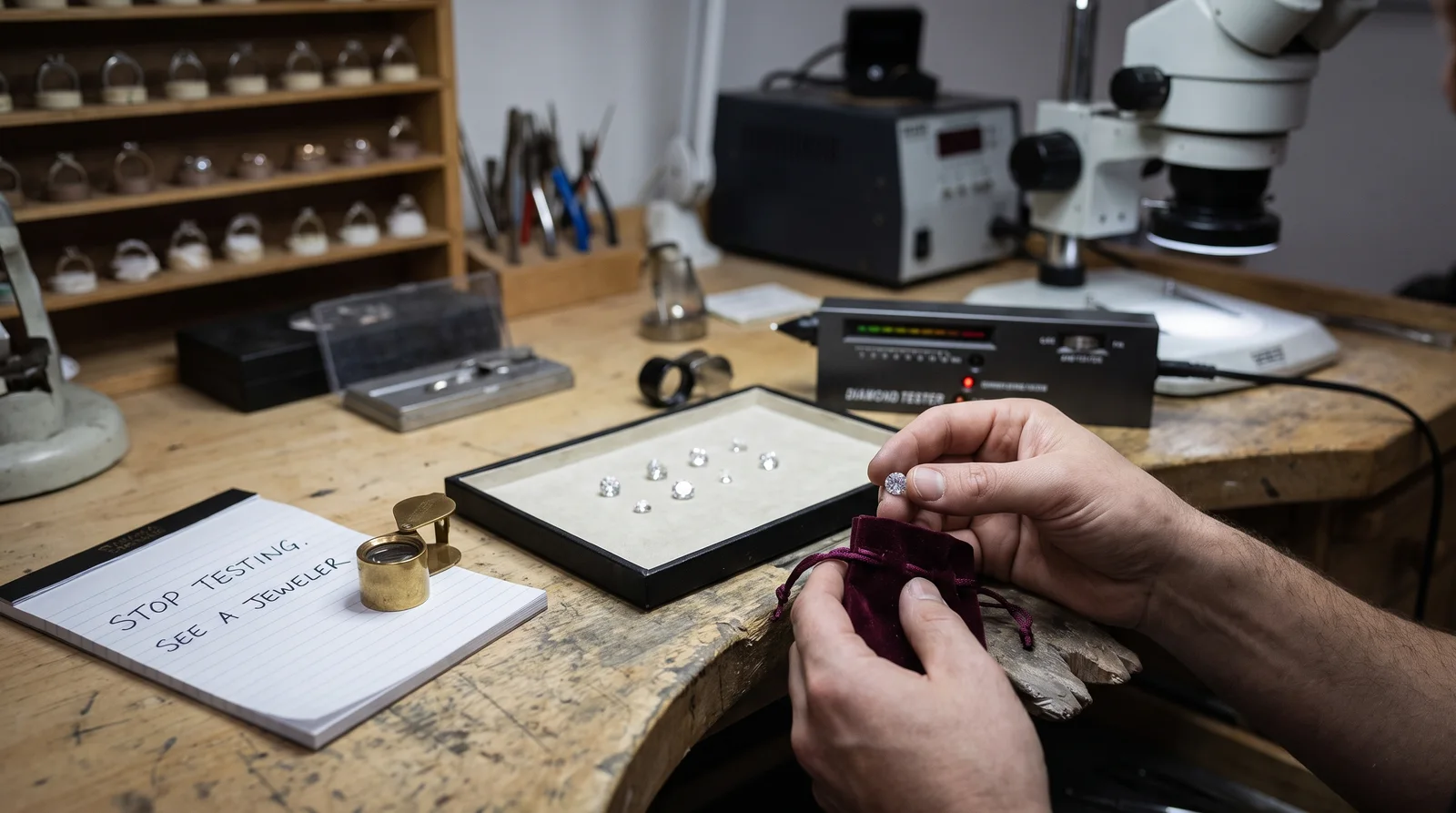
You should see a jeweler once home tests give you mixed or unclear signals. That's actually the most common outcome, not the exception.
If your stone passes the fog test but you're unsure about the flashlight look, a jeweler settles it in minutes with a dual tester and a loupe. The same goes for stones already set in a ring, where you can't run the water test or the dot test at all.
It's also worth a visit if you're planning to insure, sell, or resize the piece. A jeweler can check the setting at the same time.
While you're there, it's worth asking about signs your diamond is loose, since a wobbly stone needs focus regardless of what it's made of. And if cleaning has been overdue, ask about proper how to clean jewelry methods so buildup doesn't throw off future checks. If the visit turns up a loose prong or cracked setting, most jewelers offer repairs on the spot or shortly after.
Frequently Asked Questions About Testing a Diamond at Home
Can you test a diamond with your phone?
Some apps claim to read sparkle patterns through your camera, and a few report decent accuracy. Still, no app replaces a loupe or a proper tester pen for a real answer.
How do you tell if a mounted diamond is real without removing it?
Stick to the fog test, the flashlight test, and a loupe inspection, since those work on set stones. Skip the water test and the dot test, since both need the stone loose.
Why does moissanite pass so many home tests?
Moissanite is close to diamond in hardness and heat conduction, which is exactly why it fools basic checks. Its electrical conductivity is other though, which is why a dual-mode tester catches it and a thermal-only one doesn't.
Does a diamond certificate prove a stone is real?
Yes, a certificate from GIA or IGI confirms a gemologist examined the stone under lab cases. You can usually verify the report number online directly through the lab's site for extra peace of mind.
What's the single best home test if I can only do one?
A dual thermal-and-electrical tester pen gives the clearest single result, since it's built clearly to catch moissanite. If you don't own one, combine the fog test with a close look under a flashlight for your best guess.
Trust the Process, Not Just One Test
No home test settles this alone, and that's fine. Run the fog test, check for sinking in water, look for fire under a flashlight, and try the dot test if the stone's loose. Stack enough clues together and you'll usually know which direction you're leaning. When you want a real answer, not just a good guess, bring the stone to a jeweler who can run a proper tester and check it under magnification. That's the fastest way to stop wondering and actually know what you're holding.