How to Measure Diamond Studs for Earring Jackets Before You Buy the Wrong Pair
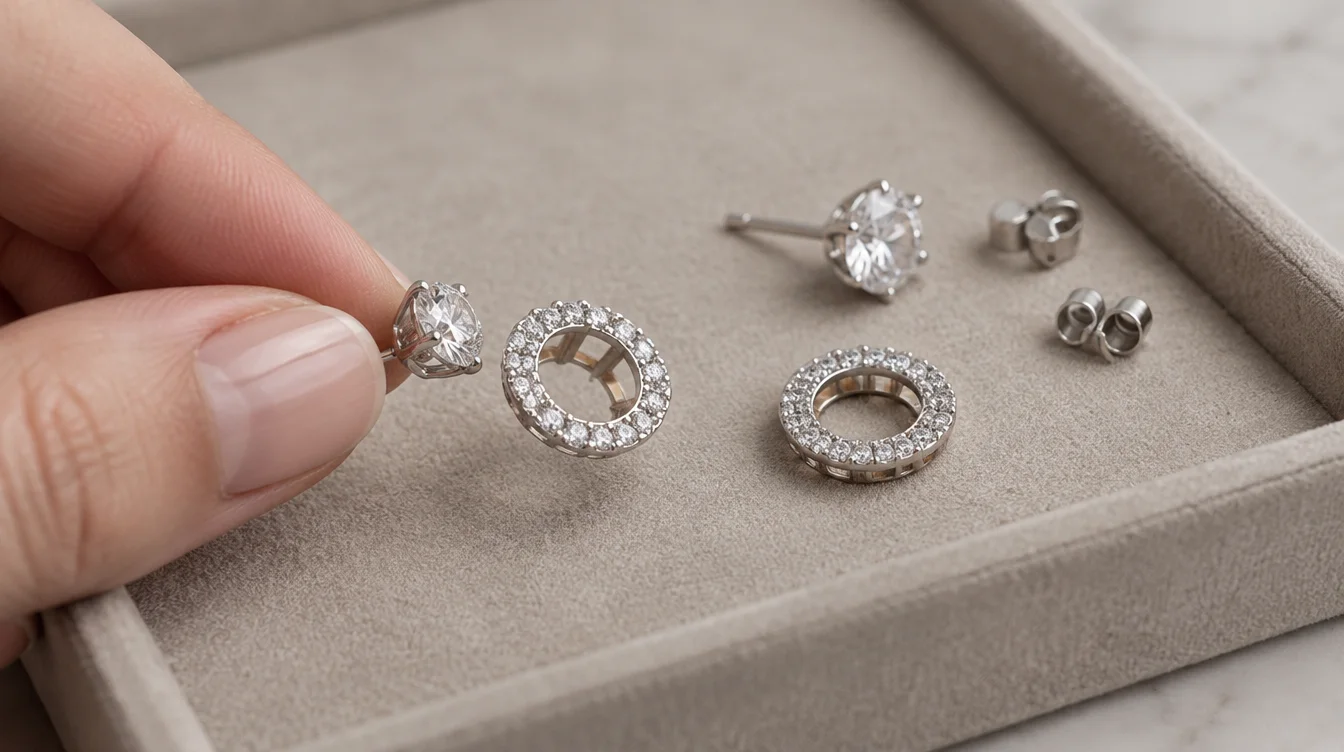
To check whether a jacket will fit your studs, measure the full mounted earring, not just the diamond. How to measure diamond studs for earring jackets takes four checks. The front must fit the opening, the setting must clear the jacket, and the post must pass through its hole. Your original back must still fasten securely. If the seller cannot confirm those dimensions, try the pieces together before buying.
How to measure diamond studs for earring jackets starts with the setting
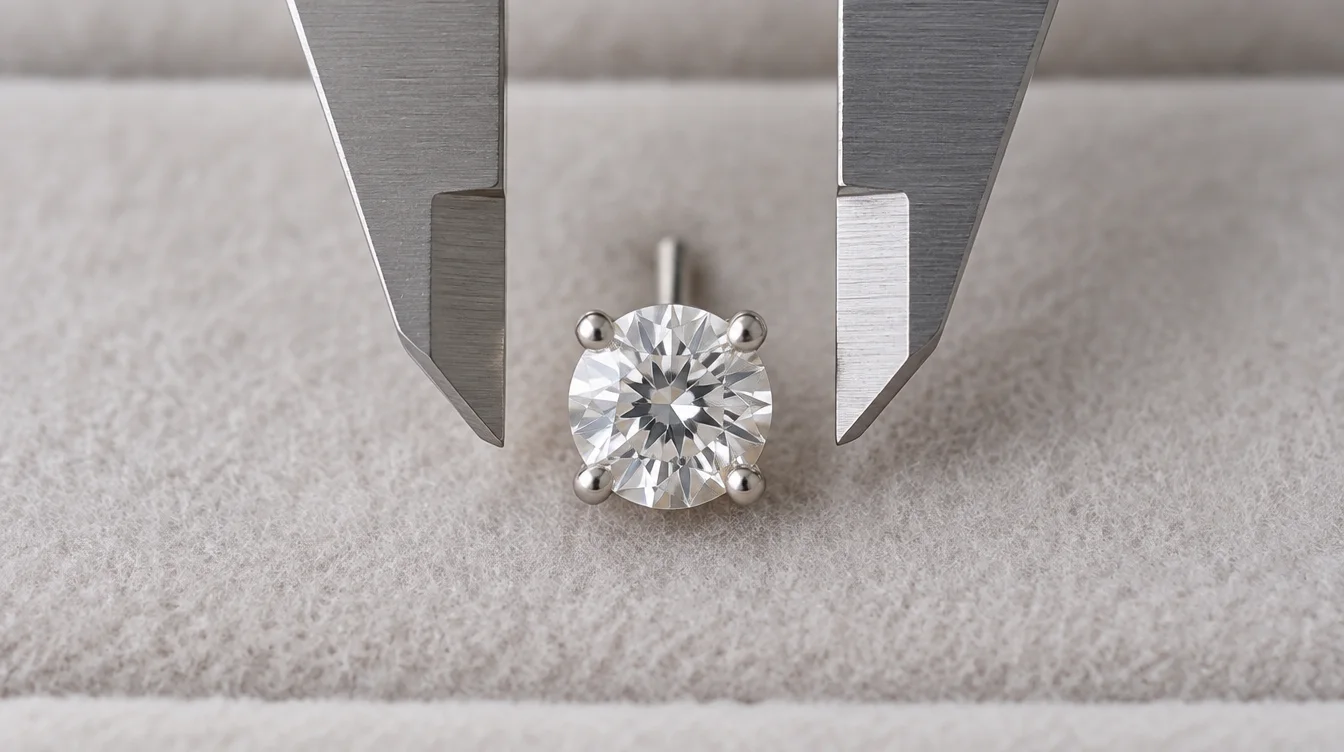
Measure the widest part of each stud’s front, including its prongs or bezel. A diamond’s stated diameter does not tell you how much room its mounting needs. A prong tip may project beyond the stone, while a bezel adds metal around its full edge. Either can stop a stud from sitting inside a jacket that looks large enough in a photo.
Measure the front you actually wear
Remove the studs and place them on a soft, flat surface. With a small ruler or caliper, check the widest point across the face of each mounted stud. Then measure its height from the base of the setting to its highest point. Record both earrings separately. Even a well matched pair can have small differences in its mountings.
Keep the tool away from the diamond and prongs if you are unsure how to use it. A jeweler can take these measurements without pressing on the setting. If a stone moves or a prong catches on cloth, have the stud checked before testing jackets. Fit should not depend on forcing a delicate part into place.
Look at the profile, not just the face
Turn a stud sideways. Note where its post joins the setting and how far the basket or bezel extends behind the front. A jacket may accept the face diameter but collide with that deeper metalwork. This matters most when the jacket has a close central seat rather than an open design.
If you need help naming your setting before you measure it, the diamond stud earring size guide explains common stud shapes. Once you have the mounted dimensions, you can compare them with the jacket’s usable space.
Which jacket dimensions decide whether the stud will fit?
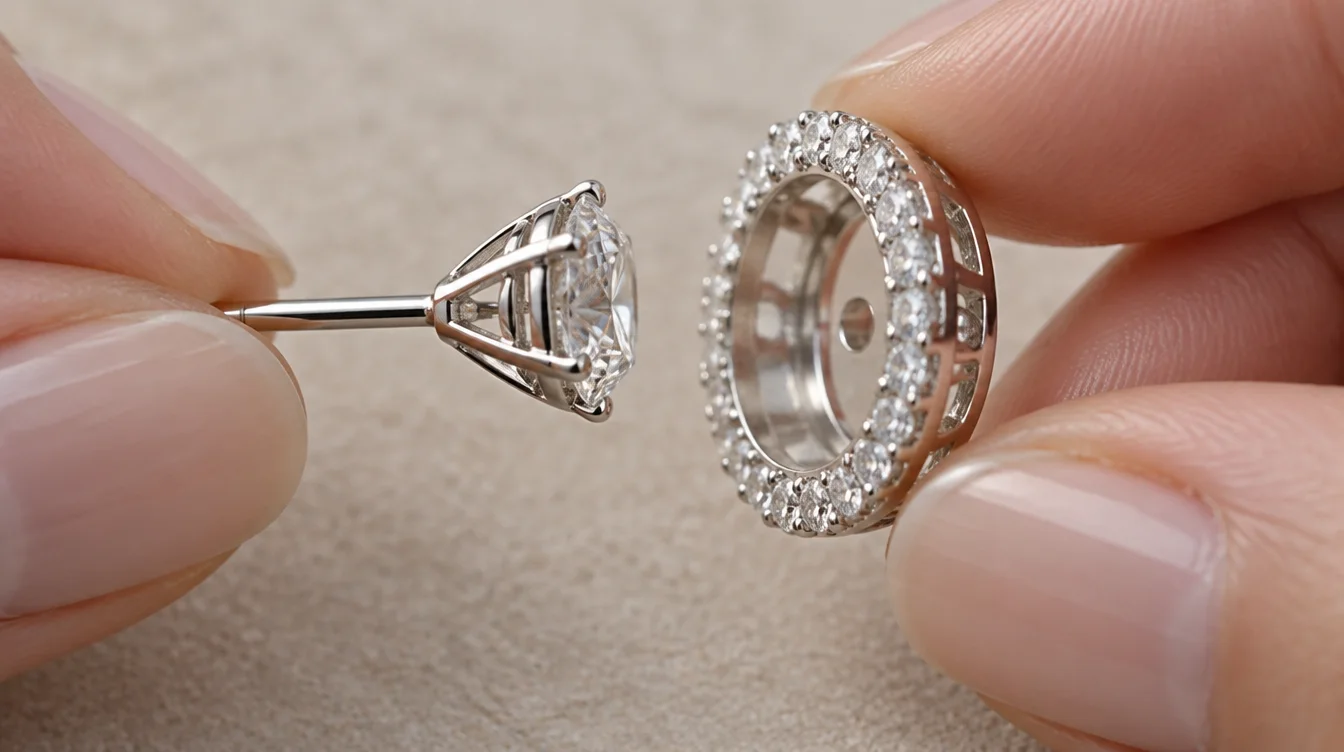
Earring jacket sizing depends on the opening, its depth, and the position of its post hole. Ask for measurements of the actual jacket, not only the diamond size or carat weight it is advertised to suit. A carat label can guide a search, but it cannot confirm fit with your setting.
Check the opening and its shape
For halo earring jackets for diamond studs, ask for the clear inside width of the halo. That means the space available to the mounted stud, measured between the nearest inner edges. Compare it with your stud’s widest front measurement. Leave visible room around prongs and bezels so the pieces do not rub or sit at an angle.
Shape matters too. A round opening may leave space around a round setting but touch the corners of a square one. Photos taken straight on can hide that contact. Ask for a clear front view with a ruler beside the jacket, or request a measurement across its narrowest usable point.
Depth changes the answer
An opening can be wide enough and still be too shallow. If the jacket forms a cup or raised frame, the stud’s basket needs room behind the diamond. Ask how far the jacket’s inner edge projects toward the stud. When that detail is not listed, a physical trial is more reliable than a guess from photos.
Post hole placement changes the look
The jacket’s hole also controls where its design sits on your ear. Some jackets offer more than one hole to adjust their height, as Borsheims describes in its fitting advice. Check which hole keeps the stud centered and places the lower edge where you want it. An opening that technically fits may still look crooked.
Once the front clears the jacket, check what happens behind your ear. That is where an otherwise promising match often fails.
Will the original post and back still work?
The post must pass through the jacket, and enough of it must remain for your original back to grip. That is a separate test from the front opening. Jackets commonly rely on an existing stud post and backing rather than supplying their own, as Clean Origin explains.
Compare the post with the jacket hole
Measure the post’s width, or ask a jeweler to do it. Then request the jacket hole’s diameter from the seller. The post should slide through without pressure, but the hole should not let the jacket wobble so much that its design turns out of place. Check both studs, especially if they were repaired at different times.
Do not enlarge a hole at home. Removing metal could weaken the jacket or change where it hangs. A jeweler can tell you whether an alteration is practical for that design.
Check usable post length with every layer in place
To check post length, put the stud through your ear, add the jacket in its intended position, and attach your own back. The back must reach its normal secure position without pressing the jacket hard against your lobe. If it barely catches, the combination does not have enough usable post, even if the stud looks perfect from the front.
Here is an illustrative way to think about the space. Suppose a post has 5 millimeters available behind your lobe, and a jacket uses 1 millimeter of that space. Only 4 millimeters remain for the back. Those figures are an example, not a fit standard. Your lobe, jacket, post, and back must be checked together.
Earring jackets for screw back studs need a closer look at the threaded section. The back must engage enough threads to fasten as it normally does. A jacket that covers the start of those threads can prevent a secure fit. Never treat one partial turn as proof that the back will stay on.
Post and back checks tell you whether the parts can assemble. The next test is whether they sit well on an actual ear.
How should earring jackets fit during an in person try on?
How should earring jackets fit? The stud should sit centered, the jacket should stay in place, and the back should close securely without pinching your ear. A small space may be part of the design, but the pieces should not grind against each other or tilt under their own weight.
Use a short fit check before paying
Bring both studs and their original backs to the jeweler. Test each jacket with the stud you plan to wear on that side. Follow this sequence rather than judging the loose pieces in your hand:
- Check that the post passes through the jacket hole without force.
- Seat the mounted stud and look for contact at each prong or bezel edge.
- Put the assembled earring on and fasten its original back fully.
- Face a mirror, then turn your head to check centering and droop.
- Wear the pair for a few minutes and notice any pressure or movement.
Do the same check on the other ear. Earlobes and piercing positions can differ, so one side may need a different jacket hole. If the frame rests too low, ask whether the design has an adjustment point. Do not rely on a tight back to pull a poorly placed jacket into position.
For halo earring jackets for diamond studs, view the pair from the front and side. From the front, look for an even gap around each stud. From the side, check that the setting is not lifted away from the lobe. Both views matter before you decide the fit is right.
A try on settles questions that measurements alone cannot. If you must buy online, the same checks become your questions for the seller.
What should you ask before buying jackets online?
Ask the seller for the jacket’s usable measurements and a return policy that allows a careful fit check. Product photos and a suggested stud carat range do not establish compatibility with your mounted earrings. Send the seller your front width, setting height, post width, and back type.
For earring jacket sizing, request the clear opening width, inner depth, post hole diameter, and hole positions. Ask whether those numbers describe the finished piece or a design target. If the seller recommends a size, check which of your measurements they used. A recommendation based only on diamond diameter leaves out the setting.
Ask one more practical question: can you return the jackets after trying them with clean studs at home? Read the conditions before ordering. If returns are limited, an in person fitting may cost less trouble than buying a pair that almost works.
When you compare two designs, use the same tests for both. A roomy open jacket may suit a taller basket, while a close halo may give a neater frame to a low setting. Neither is a safer choice until the post, back, and ear fit pass as well.
Those checks answer most buying questions. A few common edge cases deserve direct answers.
Frequently asked questions
The questions below cover the fit issues that measurements and photos can leave open.
Do earring jackets fit all studs?
No. Do earring jackets fit all studs with the same diamond size? Not necessarily, because their prongs, bezels, posts, and backs may differ. Compare the mounted pieces with the jacket rather than relying on the stone size alone.
How do you measure diamond stud earrings without a caliper?
To learn how to measure diamond stud earrings at home, use a millimeter ruler and note the widest point of the complete setting. The reading may be too rough for a close fitting halo. Ask a jeweler to measure it if the clearance looks small.
Can screw backs work with a jacket?
Yes, some earring jackets for screw back studs can work if the post passes through and the original back fully engages its threads. Test the assembled earring on your ear. Do not buy based on the label alone.
Why does a jacket fit one stud but not the other?
The two mountings or posts may differ slightly, even if the diamonds look matched. Measure each mounted stud and test each back. If one side feels tight or sits crooked, have a jeweler inspect it rather than forcing the jacket.
If either earring fails a check, use that specific measurement to find a better match.
Buy the fit, not the suggested carat size
How to measure diamond studs for earring jackets helps you avoid a pair that almost fits. Measure each mounted stud. Ask for the jacket’s clear space and hole size, then test it with your own backs. Buy only if the jackets sit centered, feel comfortable, and fasten as securely as your studs do alone.
Take your earrings and measurements to a jeweler, or send the details to the seller before ordering. If a key dimension is missing, ask for it. Your studs should not have to bend, rub, or lose their secure backs to gain a new look.