Why “will my engagement ring fit in a ring enhancer” has a hidden catch
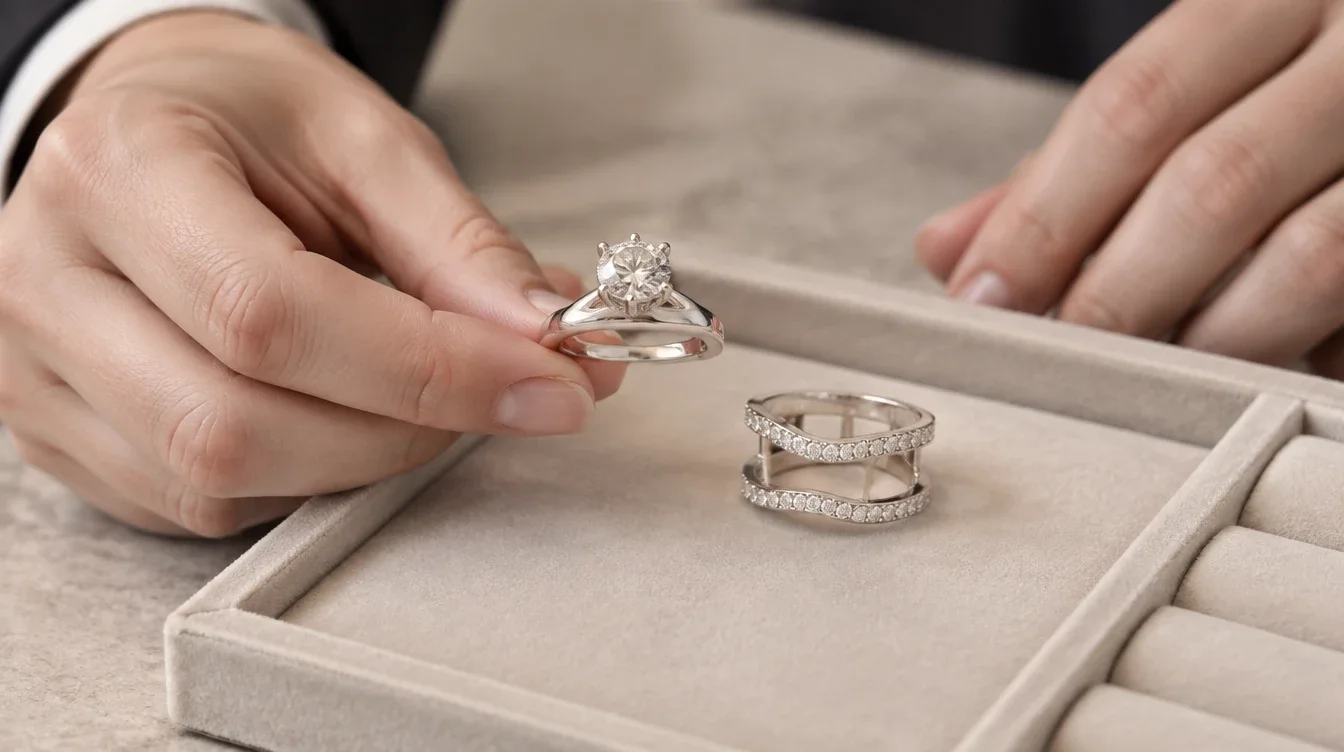
If you ask “will my engagement ring fit in a ring enhancer,” the answer is yes only if your ring can pass into the opening and sit there without pressing on a bridge, basket, or prong. Matching ring sizes alone cannot confirm that. Bring your engagement ring to a jeweler for a combined try on before buying a connected enhancer, especially if the design cannot be returned.
Why will my engagement ring fit in a ring enhancer take more than a size check?
A connected enhancer has two bands. Your engagement ring sits in the space between them. That space has its own shape and limits. Your ring must enter, sit at the right depth, and feel comfortable on your finger.
A guide to bridged ring guards describes small bars that join the outer bands. They leave room for the engagement ring to enter. Yet a bridge that clears a slim solitaire may catch a wider ring’s shoulders. The shank may then stop short of its intended place.
Start by identifying what you are buying. Some sellers use “enhancer” for a single shaped band. Others mean a connected jacket with bands on both sides. A ring enhancer overview makes that distinction. It also notes that fitted jackets can need a very specific fit. For a connected piece, the space between the bands matters as much as finger size.
Once you know the construction, check the path your ring must take through it.
Check the opening before you check the sparkle
The opening must fit the widest part of your engagement ring that passes between the bands. Do not judge the gap from one point in a front photo. The space may be narrower lower down.
Look at the whole insertion path
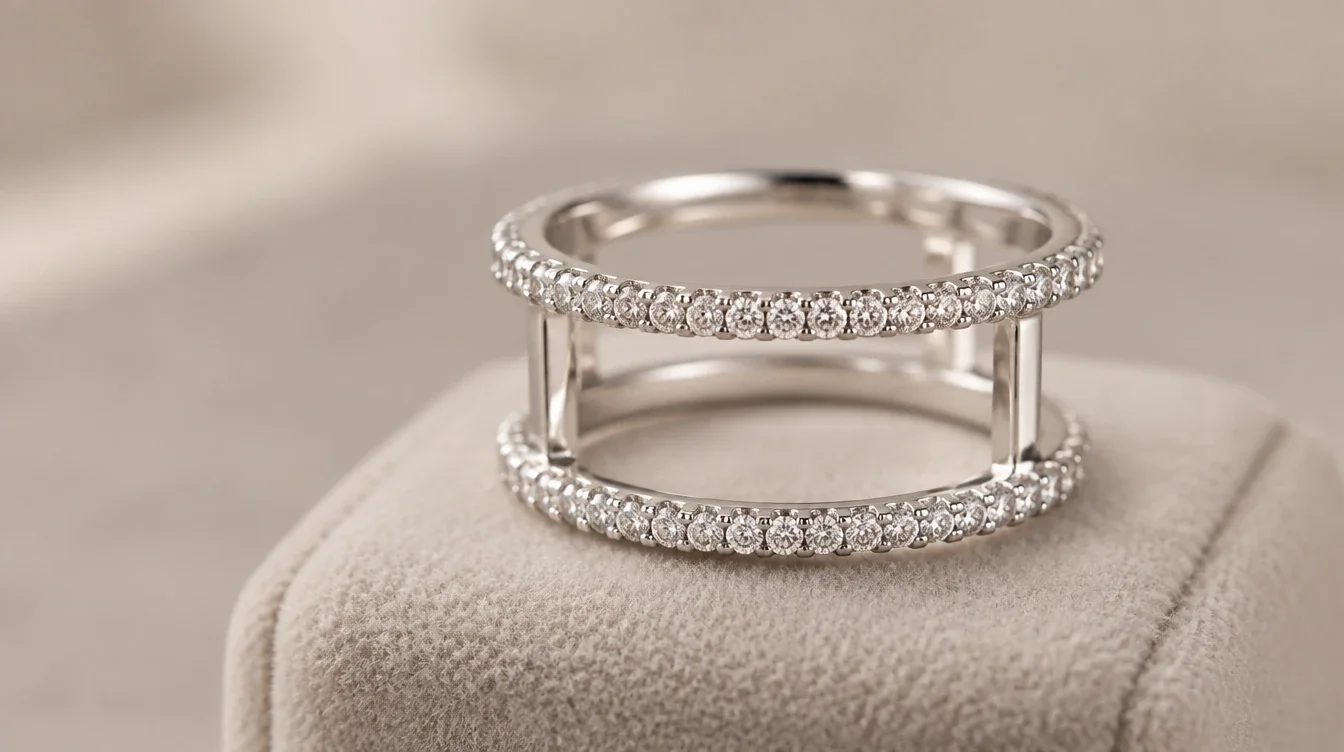
Hold your engagement ring beside the double band ring enhancer. Picture how both pieces go onto your finger. In some designs, the center ring sits between the bands as you put on the set. In others, it must slide into a fixed space. Ask the seller to show you how the actual piece works. Never force your ring through the gap.
Compare the space at the top, sides, and base. The shank circles your finger. The shoulders rise toward the setting and may be wider than the lower shank. Your ring may clear the base but stop where the jacket narrows.
Ask for dimensions that describe the empty space
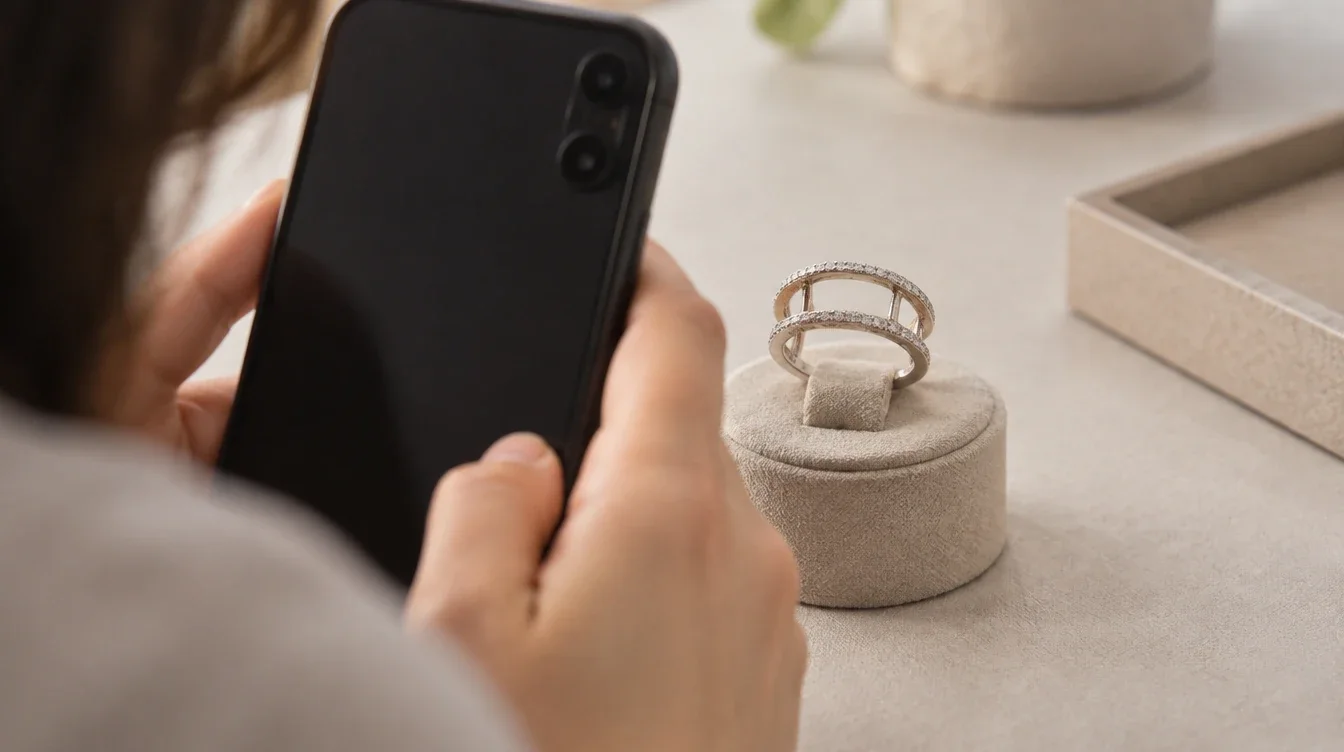
If you are shopping remotely, request clear front and side photos of the empty enhancer. Ask the seller to identify the narrowest usable opening and where that point sits. If measurements are available, ask whether they describe the space between the bands or the width of the whole enhancer. Those are different numbers.
Measure the widest part of your engagement ring that needs to enter the enhancer. Finger size alone is not enough. A jeweler can compare its shoulders and setting with the opening. Measurements may rule out a clear mismatch, but they cannot prove a safe fit. Curves, raised metal, and the entry angle still matter.
When the opening looks promising, turn the enhancer over. Its connecting bars may tell a different story.
Find every bridge that could stop your ring
A connecting bridge can block an engagement ring even when the space between the visible bands looks wide enough. The bridge may sit where a shoulder, shank detail, or lower part of the setting needs room. Its location matters more than its appearance from above.
Check the bridge from the side and underneath
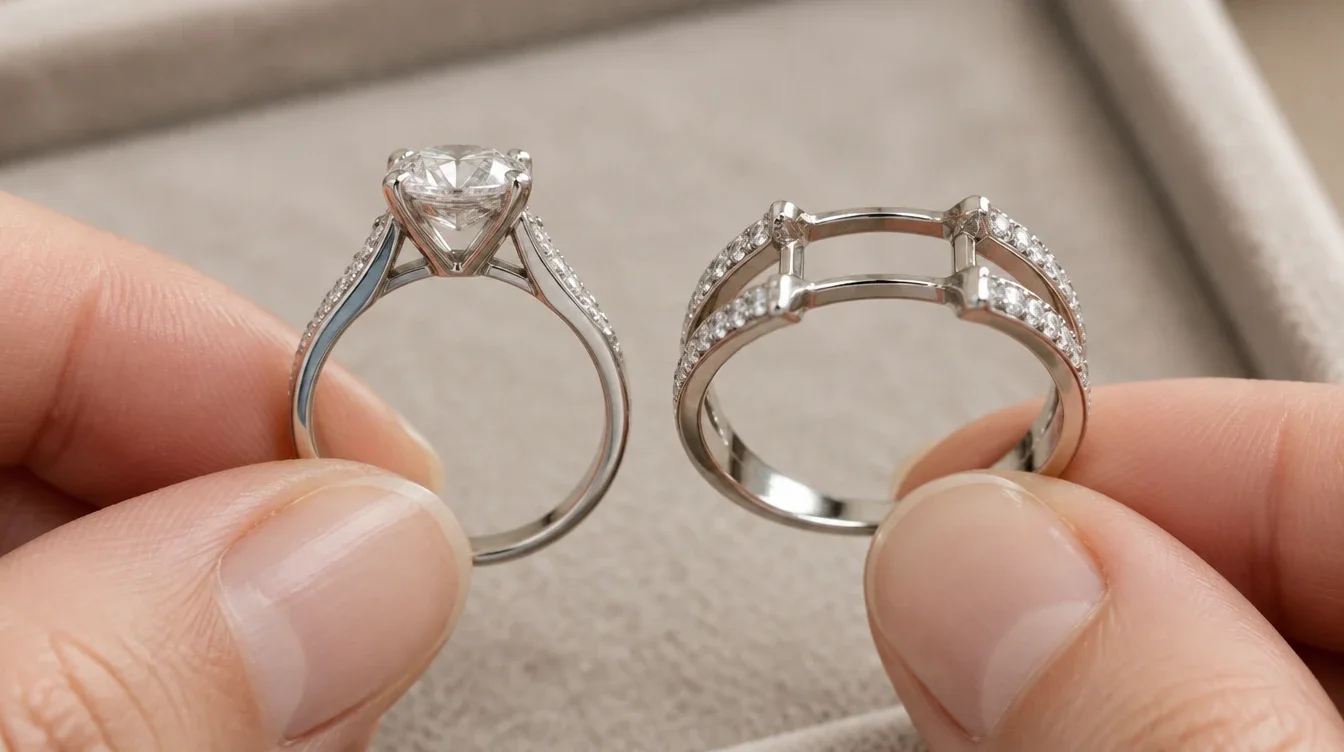
Look for each bar joining the two outer bands. Ask where it sits when the engagement ring is fully seated. A bar near the base of the finger may be clear of a simple shank. One higher up may meet a raised shoulder or decorative metal. More than one bridge means more than one point to test.
A photo of three rings lined up on a table can mislead. They may look matched from above, yet a bridge may stop the center ring from sitting down on your finger. From the side, the ring may look raised or tilted.
Watch for a ring that stops short
Suppose your ring enters the opening but its shank stops short of the outer bands. Do not assume you need a larger finger size. Find what stops the ring first. If a bridge meets its shoulder, a larger enhancer may still have the same obstruction.
Do not mistake pressure for a secure fit
A snug jacket should not press on the center ring’s setting to stay in place. If your ring catches, rocks, or needs a push, take it out gently. Ask a jeweler to inspect where the pieces touch. The set should sit steadily without using delicate setting parts as stops.
Bridge clearance settles only part of the question. The center setting must also clear both outer bands.
Check the basket, prongs, and sides of the setting
The engagement ring’s setting must sit between the enhancer bands without unwanted contact. The basket is the metal structure beneath the center stone. Prongs hold the stone at their tips. A halo, side stones, or raised gallery can add width where a plain shank has none.
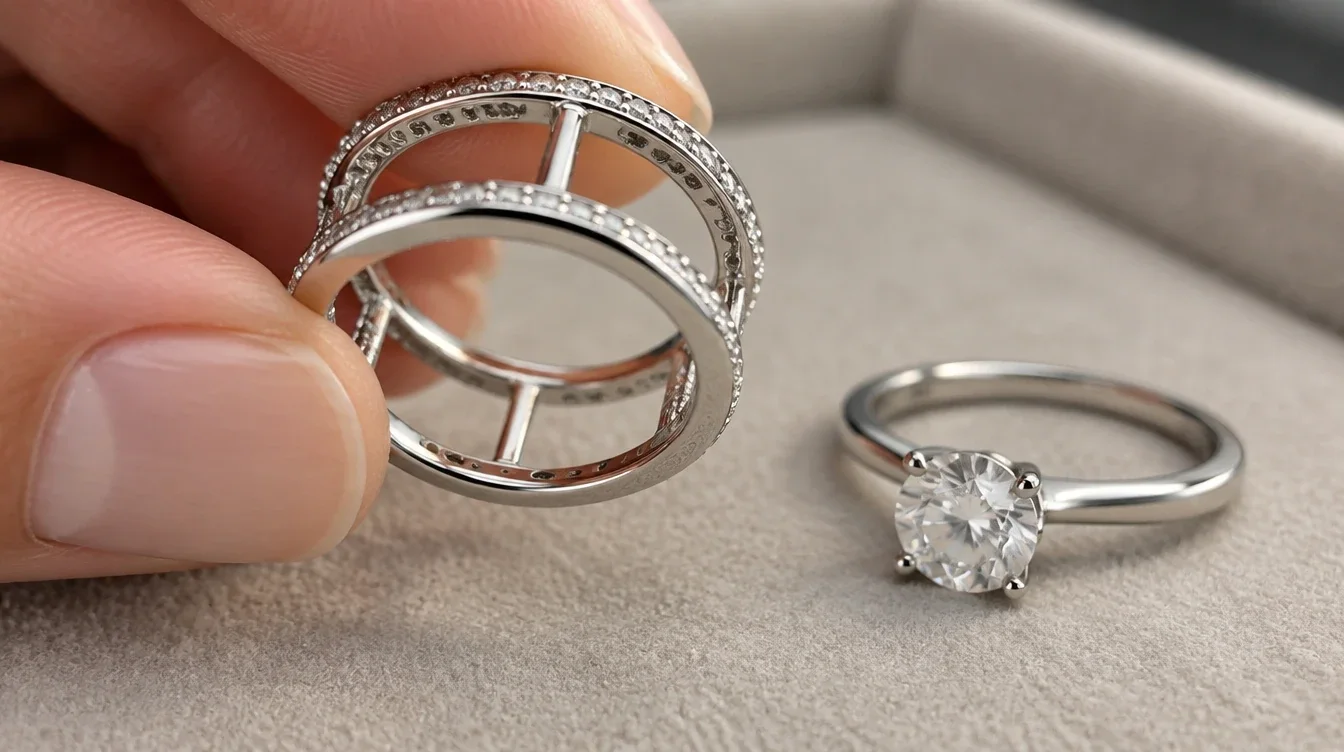
View the pair from the side at eye level. Does an enhancer band reach beneath the center stone without touching the basket? Does it press a prong from the side? A contact point may be hard to see from above, so slowly turn the rings under good light. Ask the jeweler to inspect any spot you cannot identify.
Take extra care if your engagement ring has stones along its shoulders. An outer band may touch their settings instead of smooth metal. Do not accept rubbing against a stone or prong just to close a gap. If you hear a click as the rings move, stop the try on. Find its cause before you wear the set.
Take extra care with a low setting
Shopping for a ring enhancer for low setting engagement ring designs calls for a close side view. A low basket may leave little space for the jacket’s inner edge. A curved shape seen from above does not prove the metal will clear the setting.
A ring enhancer for low setting engagement ring styles may work if its bands sit beside the basket, not under it. If the jacket needs space the setting cannot give, consider another jacket shape or two separate contoured bands. Neither is a sure fit. Try the actual pieces and check where they touch.
If the setting clears, the next question is whether the whole set feels right on your hand.
Try the complete set on your finger
A combined try on shows how the finished rings sit and move on your finger. Measurements and photos cannot show that. Use your own engagement ring, not a similar display solitaire. You need to test its shoulders, basket, and shank.
Place the rings on your finger in the order the jeweler recommends for that enhancer. Check whether each piece reaches a comfortable position without force. Then look straight down and from both sides. The engagement ring should not sit higher merely because a bridge or band is holding it up.
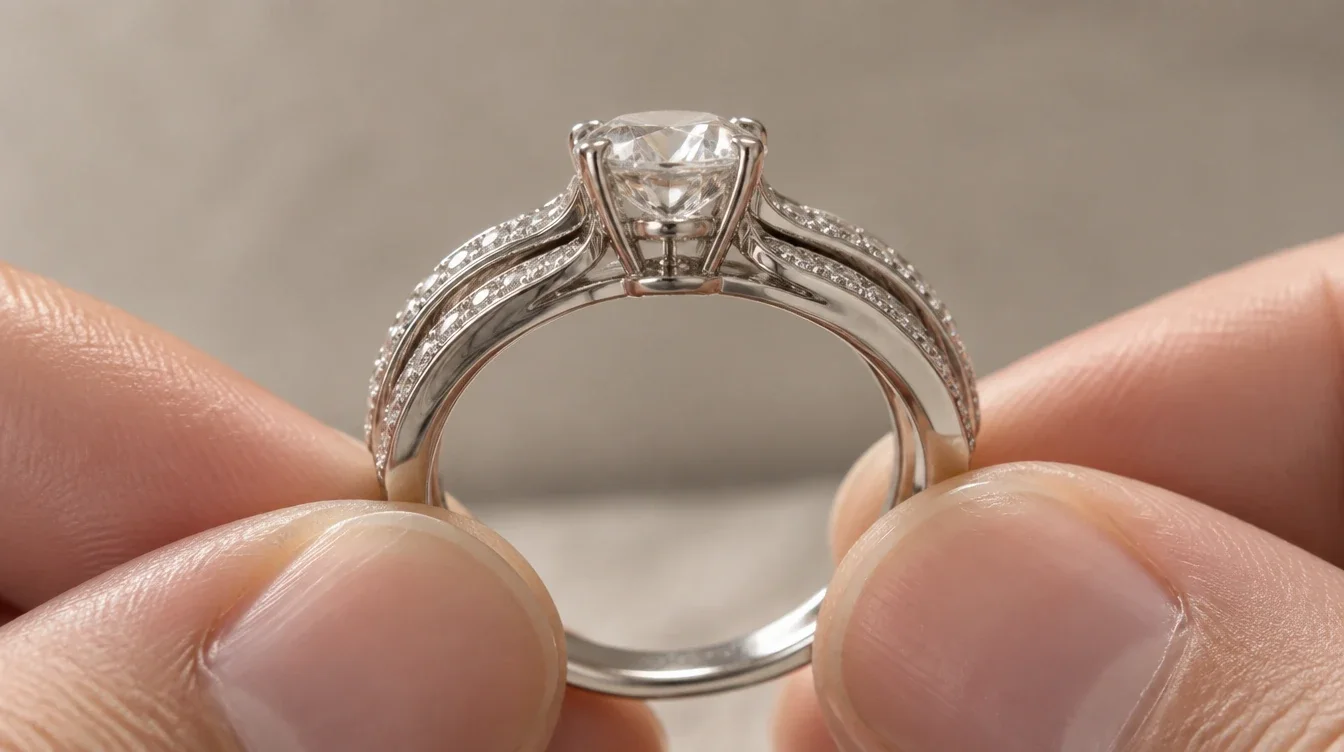
Make a loose fist, open your hand, then let it rest. Notice any pressure between your fingers or under the joined bands. The set should come off without a struggle, though your usual knuckle fit still matters. One short try on cannot predict every change in finger size. Try again at another time if your fingers tend to swell.
What does a good fit look and feel like?
If you wonder “how should a ring enhancer fit,” check three things. Your ring should enter without force. Its setting needs safe clearance, and the full set should feel comfortable as you move your hand. A small gap may be fine if nothing catches or rocks. A flush look is not worth pressure on the setting.
Ask “how should a ring enhancer fit” while the jeweler can see the rings together. Point out any lift, twist, or pinch rather than asking only whether the set looks good. That gives the jeweler a specific issue to assess before you commit.
Comfort on your hand leads to a related question: which part, if any, needs a size change?
Keep finger size separate from enhancer compatibility
Ring enhancer sizing concerns how the enhancer fits your finger. Compatibility concerns whether your engagement ring fits inside the enhancer’s structure. The two questions connect, but they are not the same. A larger jacket may feel looser on your finger while leaving its internal bridge in exactly the wrong place.
So, should a ring enhancer be the same size as engagement ring? Not by rule. The answer depends on the enhancer’s width and inner shape. Your current ring fit and the feel of the full set matter too. Ask a jeweler to size your finger with a band like the finished set. Then try the actual rings together if you can.
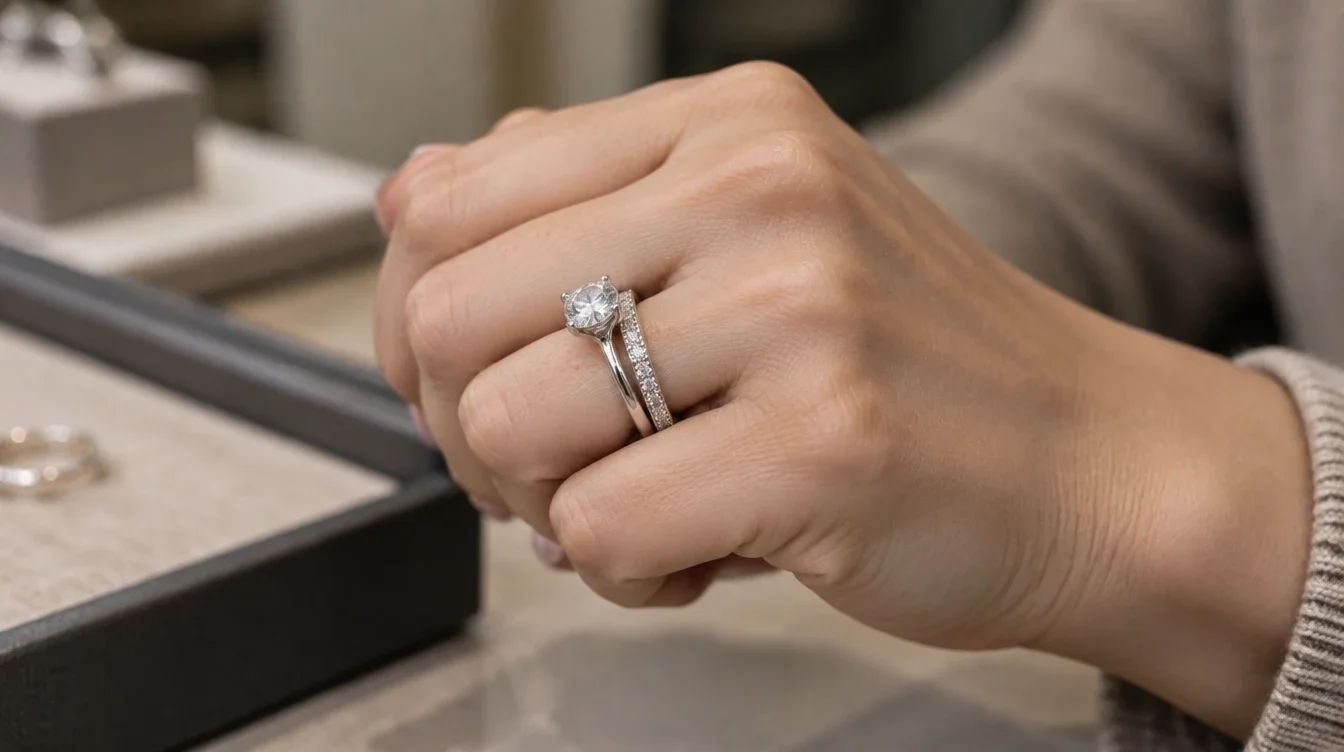
Do not order a size change based on a stranger’s experience with another design. In the supplied discussion about enhancer sizing, wearers report different results, from keeping their usual size to going slightly larger. Those comments are useful evidence of variation, not a sizing rule for your ring.
Before changing ring enhancer sizing, ask what problem the change should fix. Finger pressure points to size. A shoulder hitting a bridge points to shape. Basket contact points to clearance. Find the cause first, or the size change may not help.
That distinction is especially useful when a seller offers a larger size as the only answer to a failed try on.
Know when to choose another construction
Choose another enhancer if the connected design will not admit your ring or clear its setting. You do not need to force your ring into a jacket made for another shape. Compare each option in the same way. Check entry, setting clearance, comfort, and how steadily the pieces sit.
A double band ring guard with a different bridge position may solve an obstruction while keeping the joined look. Ask to see its underside before treating the name as a promise. A double band ring guard can have a very different opening from the one you first tried.
Two separate contoured bands have no connecting bridge. They may give you more freedom to place one on each side. Each band still needs the right curve and safe setting clearance. For help choosing the outer bands, see the comparison of wedding ring styles. That decision is separate from testing whether a fixed jacket admits your ring.
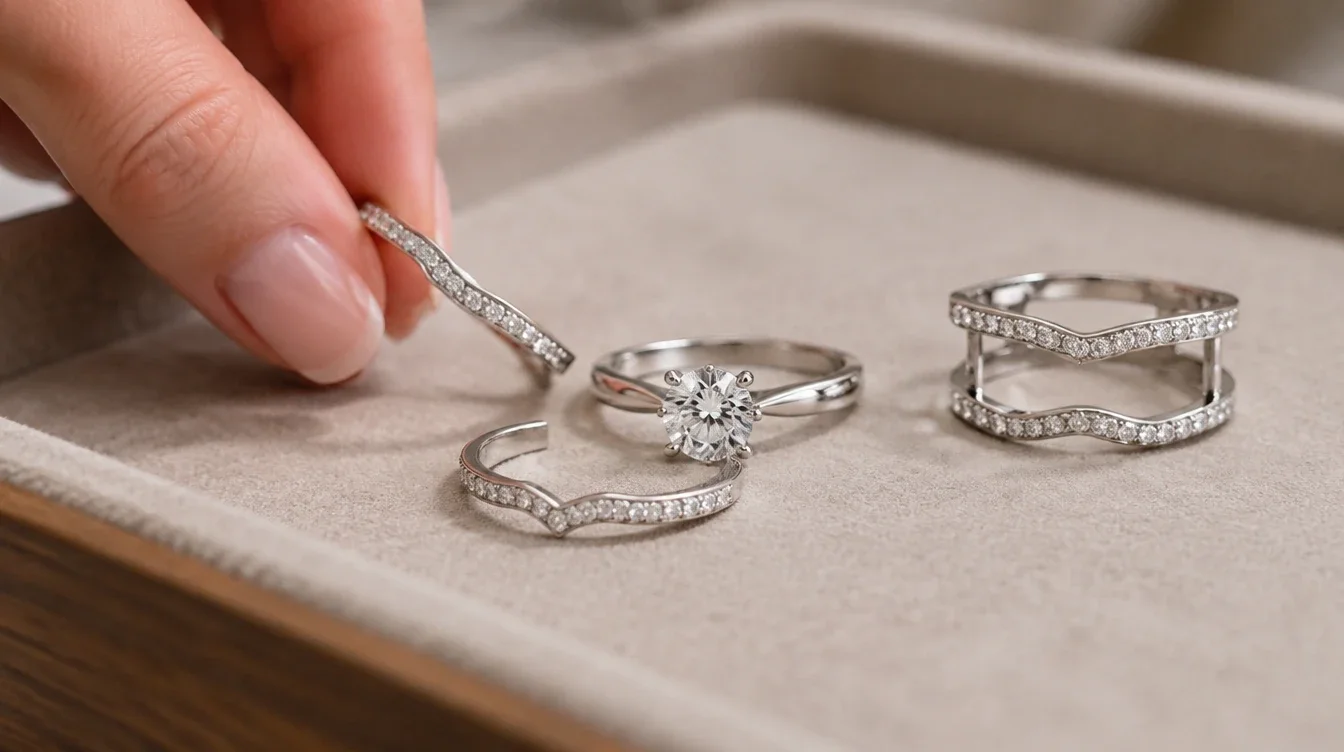
A custom fitted enhancer may be worth discussing if you want a joined design. It may also help when ready made pieces stop at the same point. Bring your engagement ring to the maker. Ask which dimensions they will use, whether you can inspect a model, and how they handle a fit adjustment. Do not approve the design from a face up image alone.
With those options in mind, a few quick questions can help you make the purchase decision.
Frequently asked questions about connected enhancers
These answers address the fit questions that often remain after a first try on. If your ring has an unusual setting or visible wear, ask a jeweler to inspect the actual pieces.
Can any engagement ring fit a connected enhancer?
No. A connected enhancer needs an opening and bridge layout that suit your engagement ring’s shank, shoulders, and setting. If the ring stops short or presses on the basket, choose another design rather than forcing the fit.
Does a matching ring size mean the pieces will fit together?
No. Matching finger sizes do not describe the space between enhancer bands. Check the opening, bridge position, and setting clearance with both rings together.
Why does my engagement ring sit higher inside the enhancer?
A shoulder, basket, or shank detail may be meeting a bridge or outer band. Remove the set and have a jeweler locate the contact point. Do not assume a larger finger size will lower the ring.
What should I ask before ordering an enhancer online?
Ask for front, side, and underside views. Ask the seller to describe the opening and each bridge position. Share photos and relevant measurements of your ring. Check return or adjustment terms before ordering. Photos alone cannot prove the pieces will fit together.
Those answers all point to one final check: see the two pieces together before the sale is final.
Bring your ring to the decision
“Will my engagement ring fit in a ring enhancer” is not a question a size chart can settle. Your ring must enter the opening and clear every bridge. It must sit without pressure on the setting and feel good on your hand.
Take your engagement ring to a jeweler and try it with the exact enhancer you want. If you shop online, request the views and terms you need before paying. A good match should be easy to place, clear to inspect, and comfortable to wear. If you have to push it into position, keep looking.