How to match trillion side stones without making your center stone look smaller
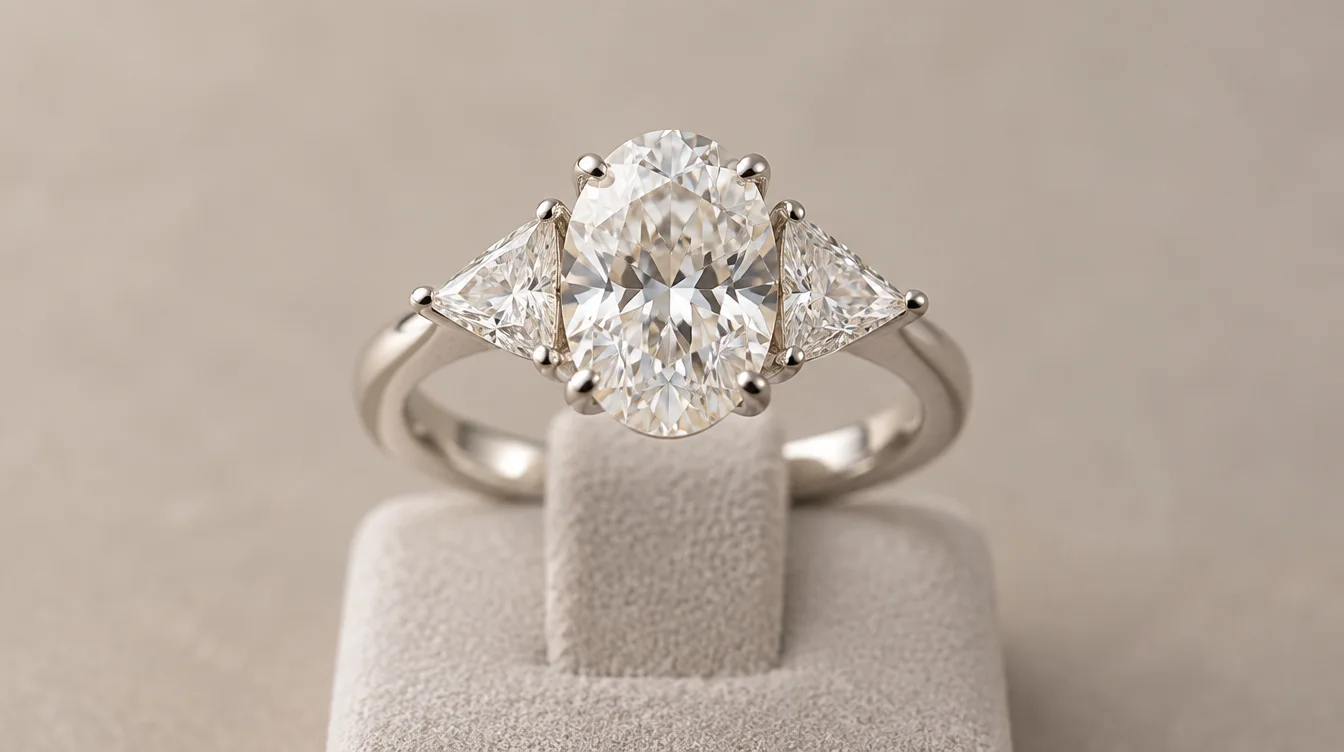
To learn how to match trillion side stones, compare how the two diamonds look face up, then judge how they frame your chosen center stone. Match their visible size, triangular outline, color, and sparkle before you compare carat weights. A jeweler should also confirm that the proposed setting protects each pointed corner; a balanced pair is not a good choice if its tips cannot be set safely.
How to match trillion side stones when the center is already chosen
Start with the center stone’s measurements and a photo of the ring design. Side stones should lead the eye to that center, not compete with it. A matched pair trillion diamonds can look lovely alone but wrong beside your chosen oval, round, cushion, or colored gem.
Ask for the center stone’s face up size in millimeters. For a round stone, note its diameter. For an oval or cushion, note its length and width. View the side stones at the angle they will have in the ring. Measurements give you a starting point. A full layout shows whether the three shapes work together.
There is no single correct size ratio for every ring. A broad center can carry more visible side stone than a narrow one. Finger size, band width, and the distance between stones also change the result. [GIA’s advice on selecting side stones](https://4cs.gia.edu/en-us/blog/select-diamond-side-stones-engagement-rings/) likewise asks buyers to consider both the center stone and the wearer’s hand, rather than treating size as a stand alone number.
Decide which look you want before shopping. Small trillions act like bright shoulders and leave the center in charge. Larger ones spread sparkle across the finger and give the ring a stronger three stone look. Neither choice is wrong. Trouble starts when the pair is chosen in isolation and the center’s shape gets lost.
Once you know the look you want, compare the size readers will actually see.
Why face up size matters more than carat weight
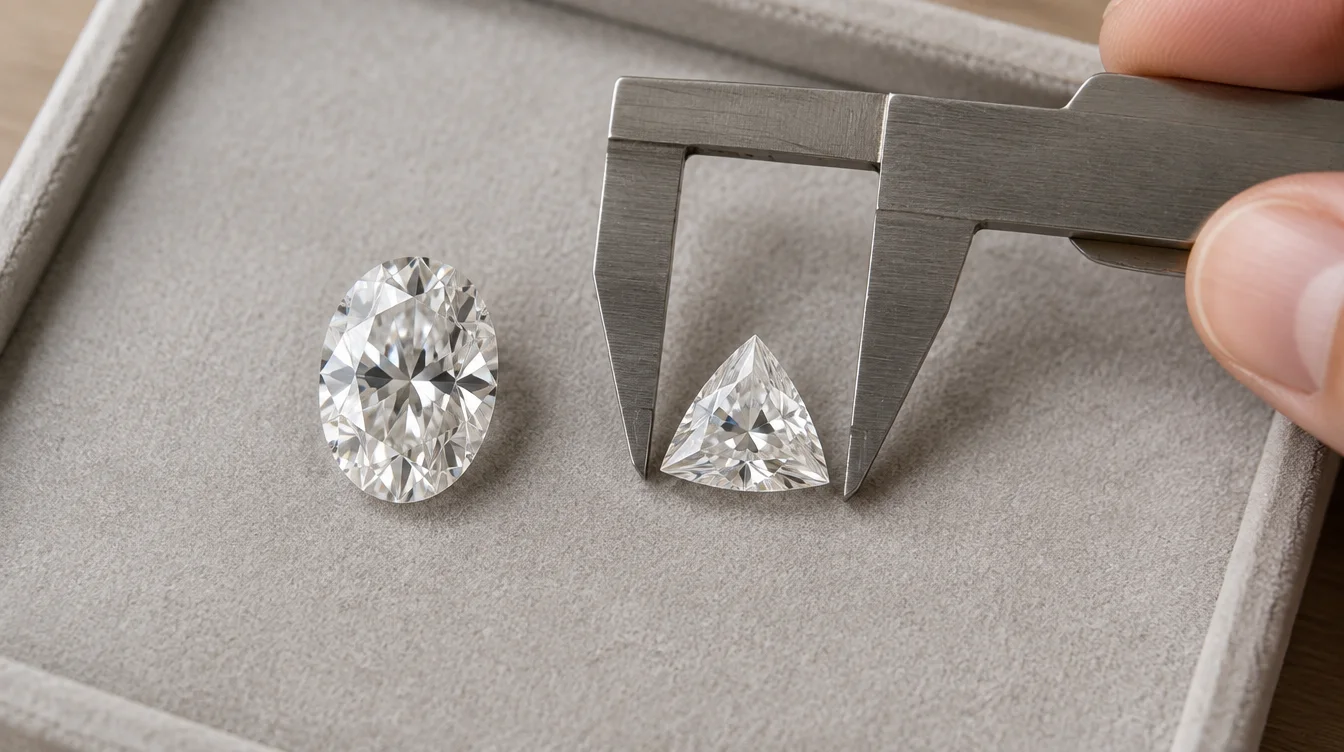
A diamond side stone size ratio is most useful when it compares visible size, not weight alone. Carat describes weight. Your eye sees each stone’s outline from above. Two trillions can weigh the same but look different. One may spread wider; the other may carry more weight below the girdle.
Ask for each stone’s measurements, including depth. Do not choose from a measurement sheet alone. Outline and cutting affect how large each stone looks. Place both beside the center, or ask for a scaled face up image of all three. If the pair will sit at an angle, the image should show it.
A simple way to compare visible reach
This is an example, not a recommended industry ratio. Suppose your center measures 8.0 millimeters across the ring. In the planned layout, one trillion reaches 3.0 millimeters from its inner point to its outer edge. Divide 3.0 by 8.0. Its visible reach is 37.5 percent of the center’s width.
Now suppose another trillion reaches 3.6 millimeters in the same direction. That equals 45 percent of the center’s width. Its reach is 20 percent greater than the first stone’s. The change may sound modest. In a three stone ring, it can shift the look from a clear center to a broad row of diamonds.
Use the calculation to compare options, not as a pass or fail rule. The inner points, the gap beside the center, and the band’s slope affect what you see. Prongs or a bezel may need extra room. A sketch of bare diamonds can make the finished ring seem less crowded than it will be.
Keep both side stones equal to the eye
For a matched pair trillion diamonds, view both stones in the same light. Compare the reach from each inner point to its outer edge. Then check their height on the finger. Similar measurements can still look uneven if one triangle has a broader belly or a sharper point.
Small differences may disappear once the stones are set. Do not demand identical numbers at the cost of a poorer visual match. Ask the jeweler which differences will remain visible after the metal covers the corners. If the answer is uncertain, request a layout with the intended setting drawn around the stones.
Size gets you close. Shape is what makes the pair feel intentional.
Match the triangular outline, not just the size
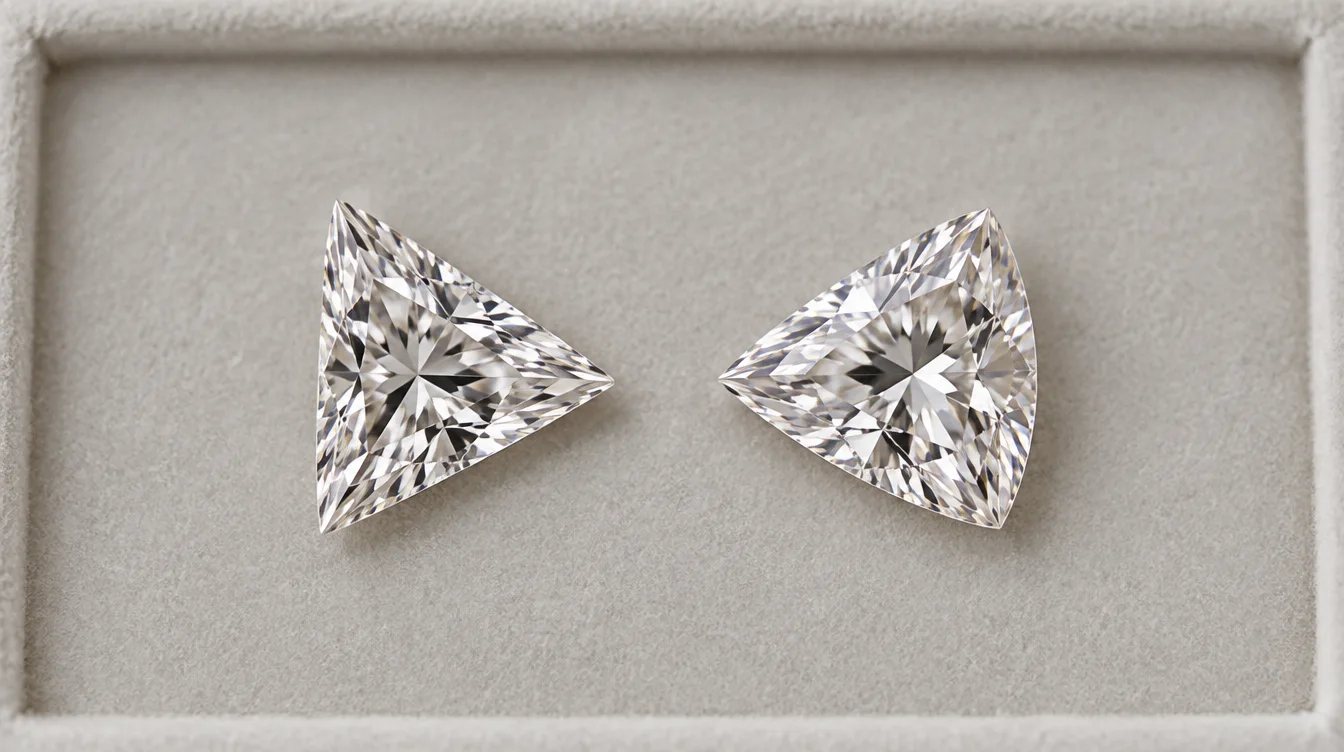
Matching side stones to center diamond shapes starts with two triangles that look alike. Compare their side curves, corner points, and base widths. Some trillions have nearly straight sides. Others have clear curves. Place one of each beside a center stone, and the pair may look uneven.
If the inner points will face the center, view the stones that way. Compare the left stone with the right. Their outer edges should slope toward the band in much the same way. The stones need not be exact copies. Their outlines should look alike at normal wearing distance.
Check the outline from three views
First, view the diamonds face up against a plain background. Their edges will be easier to compare. Next, place them beside the center stone. Finally, view the planned ring on a hand or a hand scale image. You can then judge the pair, its fit with the center, and the ring’s scale on the finger.
Do not let a close camera shot make every tiny difference seem serious. The ring will usually be seen at arm’s length. Equally, do not dismiss a mismatch that still catches your eye at that distance. If you notice one side first every time, keep looking for another pair.
Let the center shape guide the outline
A round center often works well with a clear triangular contrast. With an oval, a slightly softer outer curve can echo the center without copying it. A square cushion may suit either style, depending on its corner shape and the setting. These are design choices, not rules about which diamond shape is allowed.
For a colored center gem, check the outline against the gem’s actual cut. Two sapphires with the same named shape can have quite different curves. The goal is not to make all three stones look alike. It is to give the eye a clear path from the side diamonds to the center.
After the outlines agree, compare what happens when light moves across the stones.
Compare color and sparkle in the same light
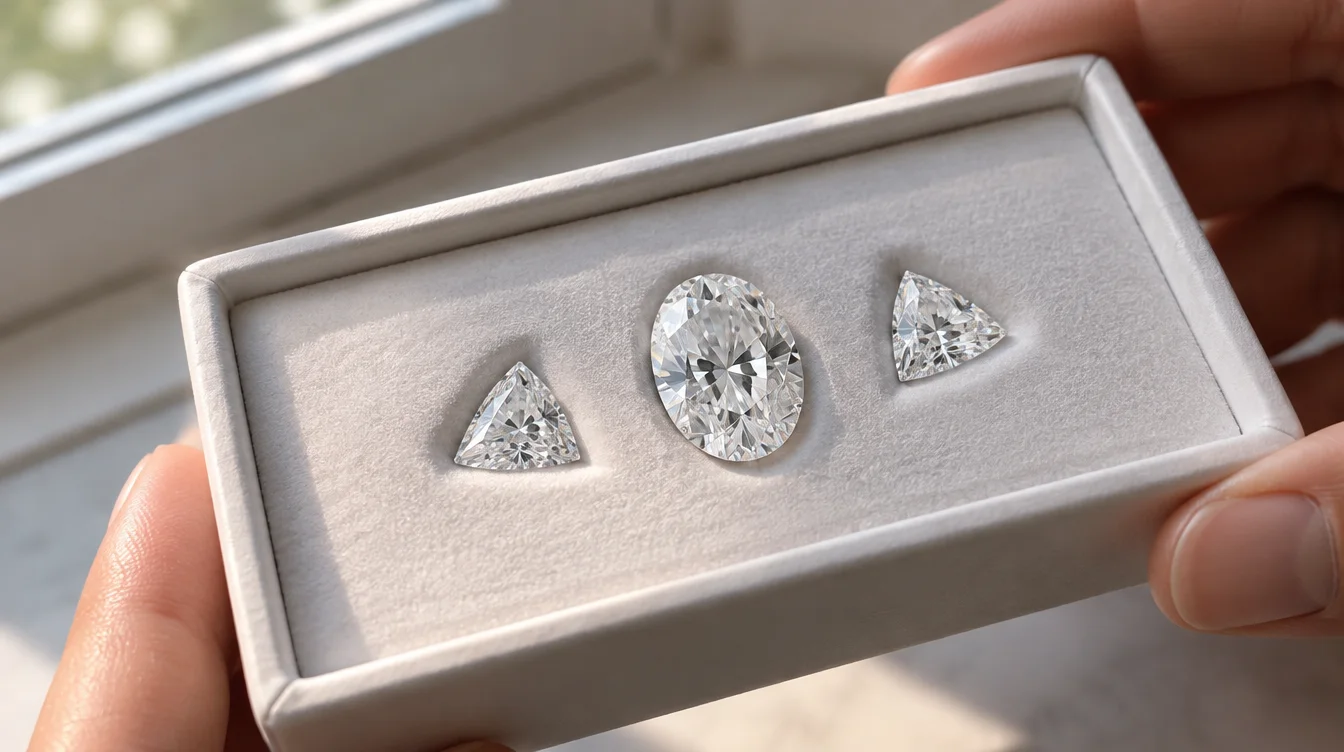
Trilliant side stones should look alike in the light where you will wear the ring. Compare them beside the center, not under separate lamps or in separate listing photos. Lighting, camera settings, or cut can make one stone look brighter or warmer. A side by side view shows the difference you need to judge.
For a colorless or near colorless diamond center, seek side stones that look compatible face up. GIA says side diamonds within a color grade or two of the center can look consistent. It also advises buyers to consider cut and clarity. Use that as a starting point, not a promise of a match. See [GIA’s side stone guidance](https://4cs.gia.edu/en-us/blog/select-diamond-side-stones-engagement-rings/) for the full context.
Color stands out more when the side stones differ from each other. A slightly warmer pair may look planned in yellow gold, especially beside a warm center. One warm side stone and one cool one can look accidental. View both against white, then in the proposed metal color.
Judge sparkle as a pair
Move the stones gently under steady light. Check whether both return light in a similar way. One trilliant may show bright flashes while the other looks quiet, even with matching measurements. Do not choose the quieter stone just because a number on its report looks good.
Watch for large areas that stay glassy or dark as the pair moves. A brief dark patch can change with the angle or light. A lasting difference between the stones calls for a closer look. Ask to see the pair loose and beside the center. That can help you tell whether the setting or the diamond causes the effect.
Use clarity grades as a screen, not the final test
Clarity matters most if you can see an inclusion or it sits near a weak corner. Compare the stones at normal viewing distance. Then ask the jeweler to inspect both tips under magnification. The same clarity grade does not put inclusions in the same places. Different grades may still look equally clean once set.
Beside a dark sapphire or ruby center, diamond side stones will look brighter and lighter. The center and sides do not need to match in color. The side diamonds should match each other. They should not make the center look dim by contrast. View the full layout in ordinary daylight and showroom light.
Even a well matched pair can feel off if its points face the wrong way.
Choose the orientation before approving the pair
The orientation of trillion side stones changes how a ring reads. With one point aimed inward, the diamonds can direct attention toward the center. A different rotation may create a wider, more geometric row. The right choice depends on the center’s shape, the available space, and where the jeweler can place protective metal.
Ask for both side stones to be shown in their final left and right positions. Rotating a loose triangle on a tray is not enough. A prong can hide a tip, and a bezel can soften the outline. A narrow gap beside the center may also look larger after the stones are raised to different heights.
Keep the left and right sides deliberate
Most engagement rings with trillion side stones use a mirrored layout. Each inner point or edge meets the center in the same way. Each outer side leads toward the shank. This makes small differences easier to spot. Check that both diamonds sit at the same visual angle, even if the band curves gently.
There are reasons to use a less symmetrical design, such as an unusual center outline. If you choose that route, ask the jeweler to show why it improves the ring. An intentional asymmetry should look clear from above, not like one diamond shifted during setting.
Look at height as well as width
A top view cannot show whether one side diamond sits higher than the other. Ask for a side view of the setting. The stones should look related in height and angle. They must also leave room for the center’s setting and the band. A low side stone can look smaller from some views; a high one may catch during daily wear.
If you plan to wear a wedding band, think about it now. The side stones and their settings may keep a straight band from sitting close. A [guide to stacking wedding and engagement rings](https://www.fulopjewelry.co/blog/how-to-stack-wedding-and-engagement-rings) can help you picture the gap. It can also help you decide whether a shaped band suits the design.
Once the layout looks right, the jeweler needs to judge whether it can be made secure.
Have the jeweler assess every pointed corner
Tip protection is part of choosing trilliant side stones. Do not leave it until after purchase. A trillion has pointed corners that need careful support in a ring worn often. [VRAI’s discussion of trillion settings](https://www.vrai.com/en-CA/journal/post/trillion-shaped-engagement-rings-guide?srsltid=AU7gw4W8Pc4XDBRYtPvAy7rmNvHFVKdhKzdMqxjyJiESJd0V9kCYCI1K) notes the risk at exposed points. It also describes settings that protect the triangular shape.
Ask the jeweler to inspect each diamond before you agree to a setting. They should check for damage or inclusions near the tips. They should also assess the girdle and explain where the metal will hold each stone. A drawing shows the intended design. The actual stones determine whether the seats and prongs will suit them.
Compare prongs and bezels by the same standard
Prongs can show more of the triangular outline. They must also be placed and made for the specific stones. A bezel covers more of the edge and may protect the points better. It also changes the shape you see. Neither setting is right for every pair.
Ask to see both settings at a similar scale. Check whether they cover the tips and how much diamond remains visible. Compare their height and how well each one frames the center. A setting that protects the pair but makes it look bulky may not suit your design.
When an exposed point is a warning
If a corner sticks out beyond its metal support, ask how the jeweler will protect it. They may suggest a new prong position, another setting, or a different pair. A neat rendering does not prove the tips will be safe in the finished ring.
When extra metal changes the match
More metal can make two slightly different stones look closer in outline. It can also hide the feature that made you choose them. Review the pair with the proposed prongs or bezel drawn in. The diamonds need to match as finished side stones, not only as loose stones on white paper.
Once the tips are safe, compare the layout with the finished ring in mind.
A practical final check before you approve the stones
To decide how to match trillion side stones at the final stage, compare the complete ring rather than separate diamond listings. Put the chosen center and both proposed sides in one layout. Confirm the measurements, then step back and look at the ring as a whole. Your eye should reach the center first and find no obvious left to right mismatch.
Ask for a face up image at a known scale. Get a side view and a close view of the tips, too. If the jeweler has the stones, a temporary layout helps even more. Compare the pair in soft daylight and indoor light. One bright showroom lamp can hide differences in color or light return.
Review the choice in this order: visible scale, outline, color, sparkle, orientation, then setting safety. Safety is not optional; it appears last only because the jeweler must assess the actual layout. If a pair fails one test, decide whether the difference will remain visible after setting. If it will, ask for another pair rather than hoping the band will distract from it.
When learning how to choose diamond side stones, buyers often start with grade and carat. Those facts narrow the search. They cannot show whether two triangles frame your center well. Tell the jeweler the look you want: “I want the center to lead,” or “I want strong finger coverage without losing the center.” That gives them more to work with than carat weight alone.
For a custom ring, ask who will approve the final stone layout before setting begins. You should know whether a substitute pair could be used if the first pair is unavailable. If the design changes, request a new view showing the real stones and the revised setting. The aim is simple: no surprises when you see the finished ring.
These last questions cover the points buyers most often need to settle before they say yes.
Questions about matching trillion side stones
Matching trillion side stones is a visual and setting decision, not a search for identical numbers. The answers below can help you test a pair against the center stone you already own or have chosen.
How close should two trillion side stones be in size?
The stones should look equal in their final left and right positions. Compare their face up size and outlines. Ask whether any difference will show once the tips are covered. A small difference in numbers may matter less than one much broader triangle.
Does a matched pair need the same carat weight?
No. Equal carat weights do not promise equal visible size or matching outlines. Use weight to narrow your choices. Then judge each pair’s size and shape beside the center.
Can trillion side stones make the center look smaller?
Yes. Side stones can make the center look smaller if they spread nearly as far across the finger. They may also draw more attention through their brightness. Smaller sides, more space, or a different orientation may put the center back in focus. Check the full layout before changing diamonds.
What should I ask the jeweler about the points?
Ask how each corner will be held and whether either diamond has damage or an inclusion near a tip. Request a view of the planned prongs or bezel around the actual stones. If a point remains exposed, ask for a safer design.
With those answers clear, the final choice should feel less like a guess and more like a design you can see.
Choose the pair that makes the whole ring work
The best pair may not have the closest weights or highest grades. Look for balance, room for the center to lead, and a setting made with care. Bring the center stone’s measurements and proposed design to a jeweler. Ask to see both trillions in place before you approve them.