Is Your EU to US ring size conversion chart Giving You the Wrong Size?

To convert a European ring size to a US size, first check what the seller’s European number means. An EU to US ring size conversion chart can give you a starting point, but the seller’s millimeter measurements should decide your order. If the chart does not name its sizing system or show measurements, ask the retailer before checkout.
What an EU to US ring size conversion chart can tell you
A conversion chart matches sizes across systems. It may round the US result. In the common European circumference system, size 54 means about 54 millimeters around the ring’s inside. US sizes use a different numbered scale. Read across the measurement row. Do not guess from the size numbers.
For a quick reference, the 25karats conversion chart pairs EU 50 with about US 5¼, EU 52 with US 6, and EU 54 with US 6¾. It also pairs EU 55 with US 7¼ and EU 57 with US 8. The chart rounds entries to available sizes. Use them to find a range, then check the ring you plan to buy.
Before using any of those pairs, make sure the listing means the same thing by “European.”
Identify the seller’s European sizing system first
“European size” is not precise on its own. Some sellers use inner circumference in millimeters. Others put German or Swiss numbers under a broad European label. An international chart may also show UK letters beside them.
Look for labels such as “EU circumference,” “France,” or “Germany.” If size 54 has no millimeter value, do not guess what it means. Ask if 54 is the ring’s inner circumference in millimeters. Then ask which US size the seller makes from it.
That helps explain why are ring size charts different: they may use different national systems. They may also round to different US size increments. Check the millimeter columns once you know the system.
Read circumference and diameter without mixing them up
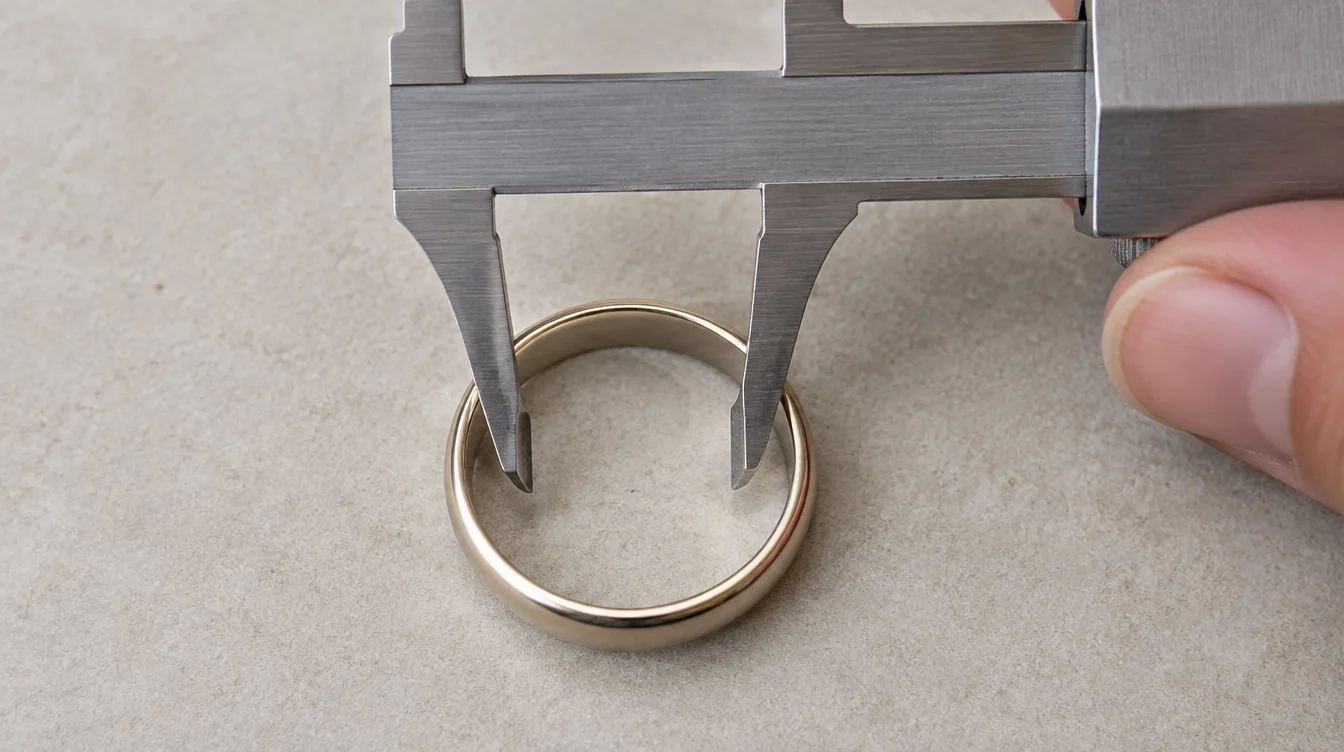
A ring size circumference chart shows the distance around a ring’s inside. An inner diameter chart shows the distance straight across the opening. Both describe one circle. Their numbers are not interchangeable. Circumference equals diameter multiplied by pi, about 3.14.
A worked check for EU size 54
Assume the seller means an inner circumference of 54 millimeters. Divide 54 by 3.14 and you get an inner diameter of about 17.2 millimeters. On the 25karats chart, 17.1 millimeters sits near US 6¾. At 17.3 millimeters, the chart shows US 7. These are approximate matches, not a promise that either ring will fit.
If you search ring diameter to US size, measure across the ring’s inside. Do not use its outside edge. The band’s thickness adds to that outside measurement and may lead you to the wrong row.
Use the matching millimeter column
If you know the circumference, read that column. If you measured across a ring’s opening, read the diameter column. A ring size circumference chart helps you check the seller’s EU number against its stated millimeters. Then check the seller’s own chart.
Test an online seller’s chart before trusting its US size
A useful seller chart names each sizing system. It also shows inner measurements in millimeters. Check one row both ways. EU 54 and a 17.2 millimeter diameter agree closely. Multiply 17.2 by 3.14 and you get about 54. If the row says EU 54 and 16.9 millimeters, ask which figure controls the order.
That mismatch is worth checking. The Ridge chart pairs EU 54 with a 16.9 millimeter diameter and US 6½. Its EU 55 row gives 17.3 millimeters and US 7. By contrast, 25karats places EU 54 near US 6¾. The charts do not give one clear answer to “ring size 54 in US.”
So why are ring size charts different when they cover the same sizes? Labels and rounding may differ. The figures in each row may differ too. Without millimeter columns, you have less to check. If two charts disagree, ask the seller which inner measurement applies.
Handle a result that falls between US sizes
A result between sizes calls for a fit choice. Do not round up by default. Ask which US size increments the retailer offers. Check each choice’s inner measurement. Near US 6¾, a shop selling quarter sizes may offer that size. A shop selling only half sizes may offer US 6½ or 7 instead.
Band width matters too. A wide band can feel tighter than a narrow one at the same stated size, as the Brilliance sizing advice notes. Tell the retailer your chosen ring’s width when you ask about size. A conversion alone cannot tell you how that band will feel.
A ring that fits the intended finger gives you another check. Measure its inner diameter. Then confirm the exact size the seller will send.
Confirm the selected size before checkout
Ask the retailer to confirm the selected US size. Get its inner diameter or circumference in millimeters too. Name the product and band width in your message. For example: “Your listing offers EU 54. Does that mean 54 millimeters of inner circumference, and what US size will you ship?” Keep the reply with your order details.
To learn how to measure ring size at home, start with a ring that fits the same finger. Measure straight across its inner opening, through the center. Then repeat the reading. You can also measure your finger with paper, but a loose wrap or stretched string can change the result. If the readings conflict, use a jeweler’s ring sizer rather than guess.
Those checks settle many questions before you order. A few common ones deserve direct answers.
Frequently asked ring size questions
The seller’s labels and measurements shape these answers. The product page’s size number alone does not.
What is ring size 54 in US?
If EU 54 means about 54 millimeters around the ring’s inside, it falls near US 6¾ to 7 on the 25karats chart. Ask which US size the seller ships for EU 54 before ordering.
How do I convert ring diameter to US size?
Measure straight across the inside of a ring that fits. Find that millimeter reading in the seller’s US diameter column. Check if the offered size is a quarter, half, or whole size.
How can I learn how to measure ring size at home?
Start with a ring worn on the intended finger that fits well. Measure its inner diameter. If you measure your finger instead, repeat the circumference reading. Check that the proposed ring can also pass your knuckle.
The size answer helps only if the retailer explains its labels.
Buy the measurement, not just the label
A conversion gets you close. A confirmed inner measurement tells you what you are buying. Check the sizing system and compare the millimeters. If either is unclear, ask the retailer. Then choose based on more than “the charts looked close.”