Is an easy to fasten front closure necklace really easier to wear alone?

Choose an easy to fasten front closure necklace by testing it at your chest, not judging its size in a photo. A toggle may suit you if you can guide a bar through a ring. A magnet may help if pinching or lining up parts is hard. Check that either clasp stays closed. If you have an implanted medical device, seek medical advice before choosing a magnetic clasp.
What makes an easy to fasten front closure necklace work?
A front closure works when you can see, reach, close, and open it without help. Putting the clasp at the front removes the need to hold your arms behind your neck. It does not, by itself, make a tiny clasp easy to use.
That difference matters when you shop. A clasp shown near the collarbone may still have a spring ring that needs a firm pinch. A larger clasp may sit so high that you must work under your chin. Start with a motion your hands can do comfortably, then find a necklace that suits it.
Reach comes before clasp style
Hold both hands where the closure would sit. For most people, the center of the upper chest is easier to see and handle than the side of the neck. Try the same motion while seated if that is how you usually get dressed. A mirror can help you find the parts, but you should not need one to feel that the clasp has closed.
Think about the whole necklace, not just its listed length. A large ring, a pendant below the clasp, or a stiff chain section can change where your fingers work. If the closure rests at your throat and makes you raise your elbows, a longer design may help. Length alone is no guarantee. The drop depends on your neck, the chain, and the clasp’s position.
Grip and alignment are different jobs
Some hands can grasp a large part but struggle to line up two small ends. Others can guide parts together yet find a spring lever painful to press. Notice which job stops you. That answer is more useful than a product label that simply says “easy clasp.”
A toggle asks you to hold a bar, pass it through a ring, and let it turn across the opening. A magnet asks you to bring two ends close enough to meet, then separate them to take the necklace off. A large lobster clasp asks you to press a lever while guiding its opening onto a ring. Those motions feel very different in the hand.
Opening matters as much as closing
Ask yourself how you will remove the necklace at night. A closure that snaps together at once may still take a strong pull to open. If you have pain or limited grip, that can turn a good morning choice into an evening problem.
For an easy to fasten front closure necklace, test the full cycle several times. Close it, wear it briefly, and open it again. Repeat without looking down. If you need to tug the chain rather than hold the clasp itself, try another design. The next step is to compare closures by the same practical measures.
Which front clasp suits your hands and your necklace?
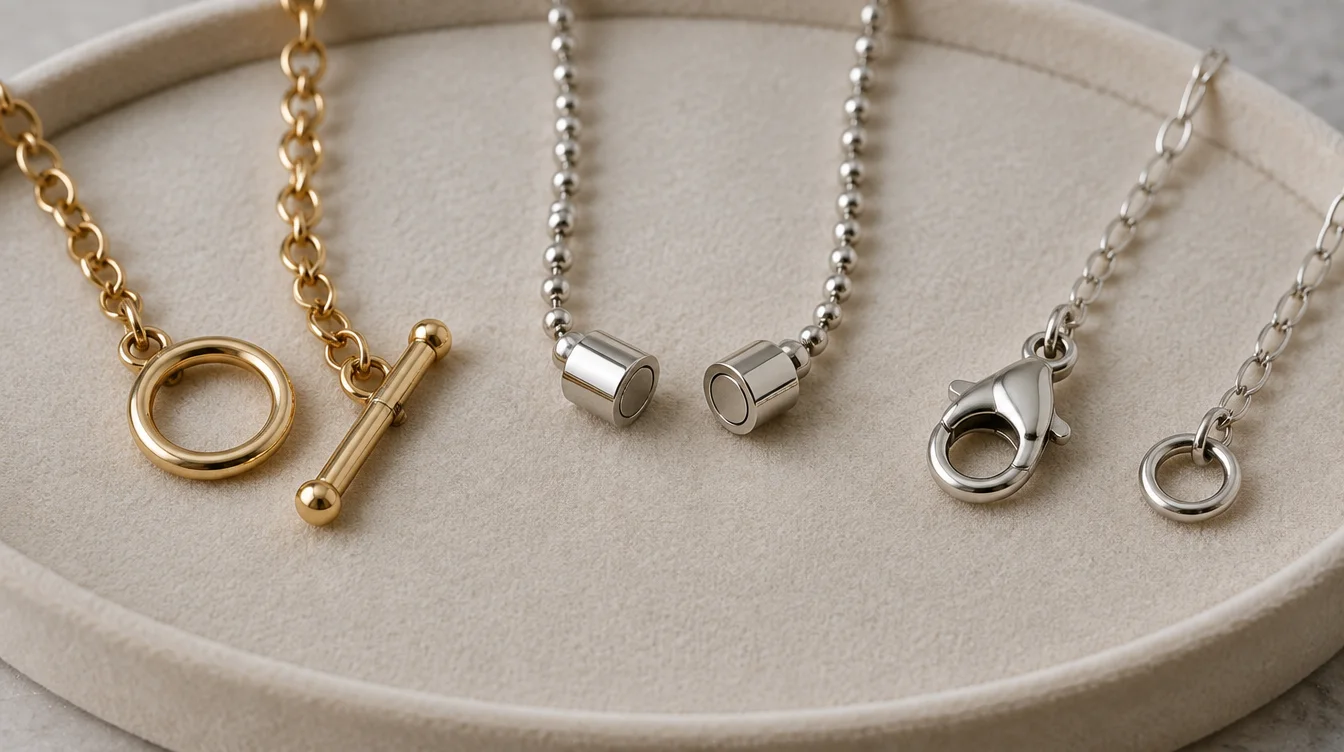
Toggle, magnetic, and large lever clasps solve different problems, so choose by motion, opening force, and security rather than style alone. None is the safest or easiest for every person and every chain.
Front toggle clasp necklace
A front toggle clasp necklace gives you two parts large enough to see: a bar and a ring. You pass the bar through the ring, then let it rest across the opening. The visible closure can also serve as the focal point of the piece. Blue Nile’s clasp overview describes toggles as decorative closures often placed at the front.
Try a toggle if you can hold the bar steady but dislike pressing tiny levers. Enough necklace weight can help keep the bar across the ring. Still, check the fit. A short bar or too little tension may let it slip back through. The Bead Traders’ clasp guide flags both fit and necklace weight as factors in toggle security.
Try the bar through the ring with your usual hand position. Then gently move the necklace as you would while changing clothes. If the bar can turn and pass back through without a deliberate fastening motion, do not rely on that toggle for the piece.
Magnetic clasp necklace
A magnetic clasp necklace may help when pinching a lever or threading a bar is hard. Bring the ends close and let them connect. That simple motion is its main appeal. Magnetic clasps are often suggested for lighter pieces. How well they hold depends on their design and the pull placed on them, as Ouros Jewels’ clasp guide explains.
Do not treat a satisfying snap as proof that the necklace will stay on. Hold the clasp itself and test how it separates. Then consider your day: scarves, bag straps, and clothing changes can pull on a chain. For a heavy or treasured necklace, a mechanical closure may be the better choice unless the magnetic design has been assessed for that specific piece.
If you have a pacemaker or another implanted medical device, ask your care team whether a magnetic necklace is suitable for you. Check the device maker’s guidance as well. Without details of your device and the clasp’s magnet, a general jewelry guide cannot give you a safe distance or an all clear.
Large lever closure
A larger lobster clasp keeps a familiar mechanical connection while giving your fingers more to hold. It may suit you if you can press a lever but cannot manage the tiny version on a fine chain. The Bead Traders lists oversized lobster clasps among easier fastening choices and advises matching clasp size to necklace weight.
“Larger” should describe the lever you press, not just the outer shell. Try it with dry hands and with the hand stiffness you tend to feel while dressing. A large target ring helps too. If you must hold the spring open while searching for a tiny loop, the bigger clasp solves only half the problem.
An easy to fasten front closure necklace should fit both your hands and the weight of the piece. A short comparison helps narrow the choice before you try one on.
How does magnetic vs toggle clasp compare in daily wear?
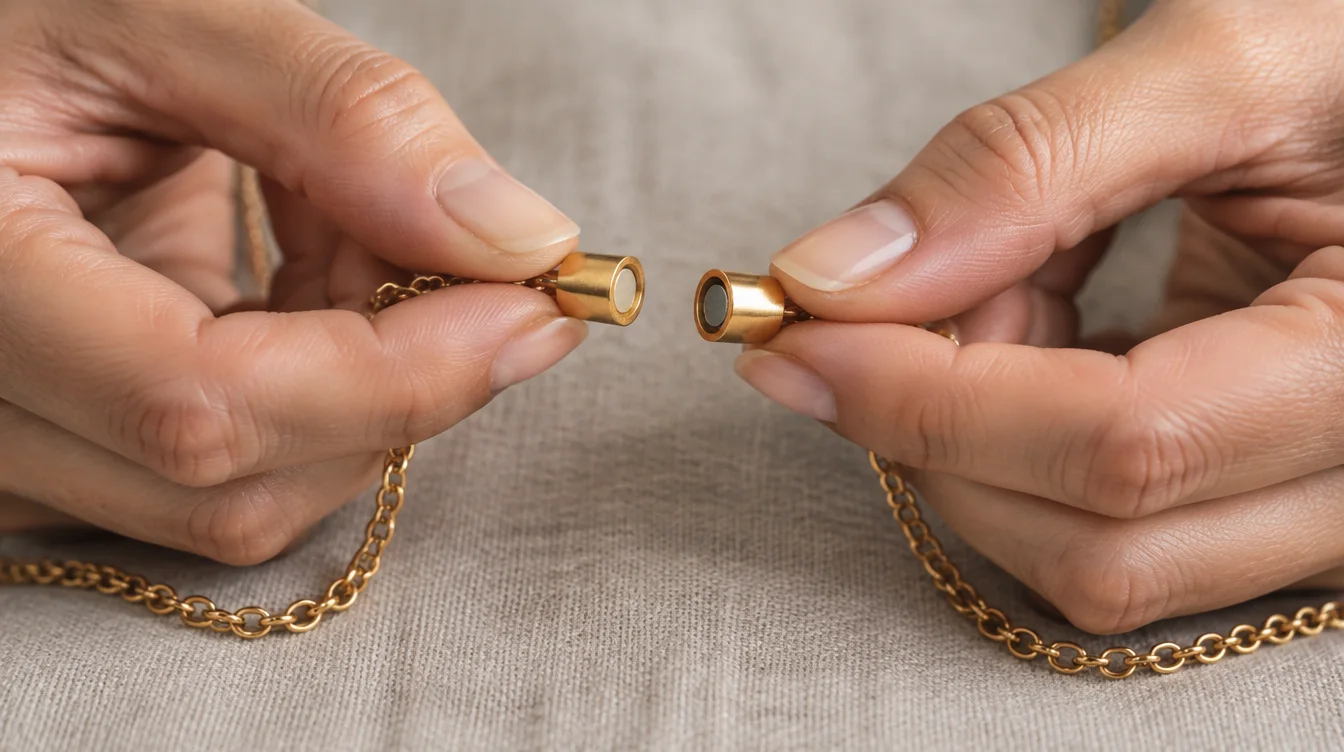
In a magnetic vs toggle clasp choice, a magnet usually takes less finger control to close. A toggle gives you a visible connection to check. Opening force, alignment, and resistance to an accidental pull still vary by design.
Reach and grip
Both closures can sit at the front, where you can work in view. With a magnet, you usually need to guide the ends close together. With a toggle, you need enough control to turn and pass the bar through the ring. If one hand has limited motion, ask whether you can steady one half against your chest while moving the other.
Do not assume that “one hand” means effortless. A smooth, small magnetic clasp can be hard to grasp when you want it off. A wide toggle bar may be easy to hold but awkward to angle through its ring. Handle the actual necklace before deciding.
Alignment and feedback
A magnet offers quick feedback when its halves meet, but you still need to confirm that nothing is caught between them. A toggle lets you see the bar across the ring. Its check is simple: look and feel for the bar resting fully across the opening, not halfway through it.
If your sight is limited, test what your fingertips can tell you. Distinct shapes may be easier to identify than two smooth ends. If your fingers have reduced feeling, a clear visual check may matter more. A clasp that is easy for one person can be frustrating for another for exactly that reason.
Security and opening force
A magnetic clasp can part when enough force pulls its ends apart. A toggle can come undone if its bar finds its way back through the ring. Design and necklace weight affect both outcomes, so broad claims about which is “secure” miss the useful question: secure on which necklace, during which activities?
Picture two necklaces. One is a light chain under a soft top. The other is a heavy beaded strand that catches on a coat collar. A suitable magnet may be worth testing on the first. For the second, ask a jeweler about a clasp made for its weight and consider a mechanical connection. These examples do not rate any clasp you have not handled.
When comparing a front toggle clasp necklace with a magnetic clasp necklace, include removal in the test. If the magnet needs more pull than your hands can manage, its easy closing motion offers little benefit. If a toggle needs careful angling each time, its larger parts may not help you either.
When a large lever makes more sense
A large lever is a useful middle path when you want a spring closure and can operate it at the front. It has a more involved closing motion than a magnet. In return, you can see the gate close around its ring. Check that the lever returns fully each time and that the connecting ring is large enough to find.
No chart can replace your own hands. Once you have picked a likely clasp style, look closely at the necklace built around it.
What should you check before buying a front fastening necklace?
Check the closure’s position, size, attachment, and feel on the complete front fastening necklace before you buy. A good clasp attached to an awkward chain can still be hard to wear.
Find the working parts in the product photos
Look for close views of the necklace both open and closed. Can you see what your fingers must hold? Is the clasp made to sit at the front, or was it moved there just for the photo? If the listing does not show how the whole piece lies, ask for a view from the back.
Pay attention to the ring or receiver, not just the decorative half. A generous toggle ring can be easy to find by touch. A large lobster clasp paired with a small jump ring may not be. For a magnetic design, check whether the ends offer a place to grip without pulling on the chain.
Check where the necklace puts the work
Try to picture the clasp against your own clothing. A flat closure may be harder to pick up from a flat top than one with a raised edge. A dangling feature can give you something to grasp, but it may also catch on a scarf. Neither detail is a flaw by itself. Your routine decides which tradeoff matters.
Chain length deserves the same care. Put a soft cord around your neck and hold its ends where you would fasten the necklace. You are not measuring a universal ideal. You are finding a place where your shoulders relax and your hands meet without strain. Compare that position with the seller’s worn photos and length information.
Inspect the whole connection
A clasp does not hold a necklace by itself. The rings and other findings that join it to the chain must suit the design. On a finished piece, look for parts that sit neatly and do not gape. For an expensive or heavy necklace, ask a qualified jeweler to check the connection rather than guessing from a photo.
Material labels need care as well. “Gold tone,” gold plated metal, gold filled metal, and solid gold do not describe the same construction. If your skin reacts to certain metals, ask what touches your skin, including the clasp and its small connecting parts. Do not assume the chain’s stated metal covers every finding.
Questions worth asking a seller
Ask whether the closure is meant to sit at the front during wear. If the photos lack scale, request its dimensions in millimeters. Ask how it opens and whether you can return it after a careful indoor try on. For a magnetic style, ask whether the seller recommends it for that necklace’s weight. A useful answer covers the whole piece, not just a claim that the magnet is “strong.”
What a listing cannot prove
A listing cannot tell you how much force your fingers can apply on a stiff morning. Nor can a photo show whether a bar slips through a ring during your usual movements. Treat product details as a way to select candidates, not as a substitute for trying the necklace.
The best easy to fasten front closure necklace should pass a short, repeatable test in your own hands. That test is more useful than a promise on a product page.
How can you test a necklace without help?
Put the necklace on, wear it briefly, then take it off with only the help you normally have. Start over a soft surface, where a dropped piece has a safer landing.
Make the first try realistic
Wear the top you would pair with the necklace. Sit or stand as you usually do when getting dressed. Keep your glasses on if you normally use them. Place the clasp at the front, then close it without asking someone to position the parts for you.
Notice where you pause. Are you reaching too high? Can you grasp each end? Do the parts meet easily, or do you have to look down and line them up several times? A successful attempt that leaves your shoulders sore is not a good result.
Try the same motion again. The goal is not speed. It is a calm, repeatable fit that does not depend on luck.
Check the hold during ordinary movement
Once closed, gently turn your head, look down, and put on the outer layer you would normally wear. Do not yank the necklace to prove a point. You want to see whether ordinary movement shifts the clasp, catches a part, or makes the closure feel uncertain.
For a toggle, confirm that the bar stays across its ring. For a magnet, check that both ends are fully joined after the necklace meets your clothing. For a lever clasp, look for a closed gate with the ring seated inside it. If any closure opens during a gentle try on, stop wearing it until a jeweler or seller can assess it.
Remove it without pulling the chain
Opening the necklace is the last part of the test. Hold the clasp, not the nearest thin link. Can you release it at your chest without twisting your wrists or tugging at your neck? If not, the necklace may not meet your main goal even if fastening it felt easy.
Repeat the test at a time of day when your hands tend to feel less flexible. Someone with variable pain may need more margin than a single good try shows. When a purchase is costly, check the return terms before wearing it outside the house.
A simple decision rule
Keep a necklace on your shortlist only if you can close and open it several times. You should also be able to place the clasp by touch or sight and confirm it stays closed during normal movement. This tests how the piece works for you, not its security in a laboratory. It does not prove that no snag can open it.
If the necklace fails, change one feature at a time. A longer chain may fix reach. A larger ring may fix alignment. Another clasp style may fix grip. That makes the next try more useful than buying the same design in a different color.
Which clasp details matter for arthritis or limited hand movement?
For stiff or painful hands, choose a clasp that avoids your hardest motion and is still secure and easy for you to open. Large parts help only if you can grasp and move them comfortably.
Match the clasp to the motion that hurts
People searching for necklace clasps for arthritis often focus on clasp size. Start by naming the motion that causes trouble. Is it a tight pinch, a small turn, a firm pull, or holding both arms up? Each points to a different change.
If pinching a spring lever hurts, test a toggle or a suitable magnet. If threading a bar through a ring is hard, try a magnetic design or a larger lobster clasp with an easy target ring. If pulling two magnetic halves apart hurts, a toggle may be easier to release. None of these choices replaces medical advice about hand pain; they are ways to assess jewelry.
Choose room for your fingers
A clasp should leave space for the fingers you actually use. Some people hold parts between thumb and finger. Others steady one half in the palm and move the other with a fingertip. Test both methods at chest height. A closure that demands a precise fingertip grip may still be difficult even when its outer shape looks large.
Texture can help you keep hold of a clasp, but sharp edges can irritate skin or catch fabric. Smooth edges and a distinct gripping area make a better pair. If you use assistive dressing tools, bring one when you shop and check whether it can reach the working part without slipping.
Consider fatigue and changing symptoms
Your easiest motion may change through the day. A necklace you can fasten once in a shop may be less manageable when you are tired. Give yourself time to repeat the full test. If you can only close it by bracing your hands against a hard surface, ask whether that surface will be available when you dress at home.
An easy to fasten front closure necklace can support independent dressing, but it should not demand a painful movement to earn that benefit. If none of the front clasps works well, a necklace that slips over your head may be worth considering, provided its opening fits comfortably and you can remove it safely. The next questions cover the choices readers most often weigh.
Frequently asked questions about front closure necklaces
These answers give you a quick starting point, but the final choice still rests on the actual necklace and your hands.
How do you put on a necklace by yourself if you cannot reach behind your neck?
Choose a necklace designed to close at the front, then hold both ends at a comfortable point on your chest. Close it, check the connection, and take it off the same way before deciding it works for you.
What is the easiest necklace clasp to fasten at the front?
A suitable magnetic clasp often needs the least precise closing motion. A toggle may be easier if you prefer to see and feel a bar across a ring, while a large lever works if pressing a spring is comfortable for you.
Can a toggle clasp come undone while you wear it?
Yes, a toggle can open if its bar passes back through the ring. Fit and necklace weight matter, so test the complete piece during ordinary movement and reject a toggle that slips easily.
Does a stronger magnetic clasp always make a necklace better?
No. A firm hold may make removal difficult, and magnetic security still needs to suit the necklace and your routine. If you have an implanted medical device, seek advice specific to that device before wearing a magnetic clasp.
Why is a large clasp still hard for me to use?
The clasp may have a tiny lever, a small target ring, or an opening motion that strains your grip. Watch which part of the task fails, then choose a design that changes that motion rather than just increasing the outer size.
Those answers narrow the field. A final choice should feel straightforward each time you put the necklace on.
Choose the necklace you can wear on your own terms
The right front closure is one you can reach, fasten, check, and remove without pain or guesswork. A toggle, magnet, or large lever may meet that standard, but only on a necklace that fits your hands and daily routine.
Start with the motion you find hardest. Try one likely style at the front of your chest, then test the whole necklace before you commit. If fastening takes repeated attempts or the clasp opens during normal movement, keep looking. Choose a piece you can wear without another pair of hands.