Could baguette vs emerald cut diamond side stones change the whole look of your ring?
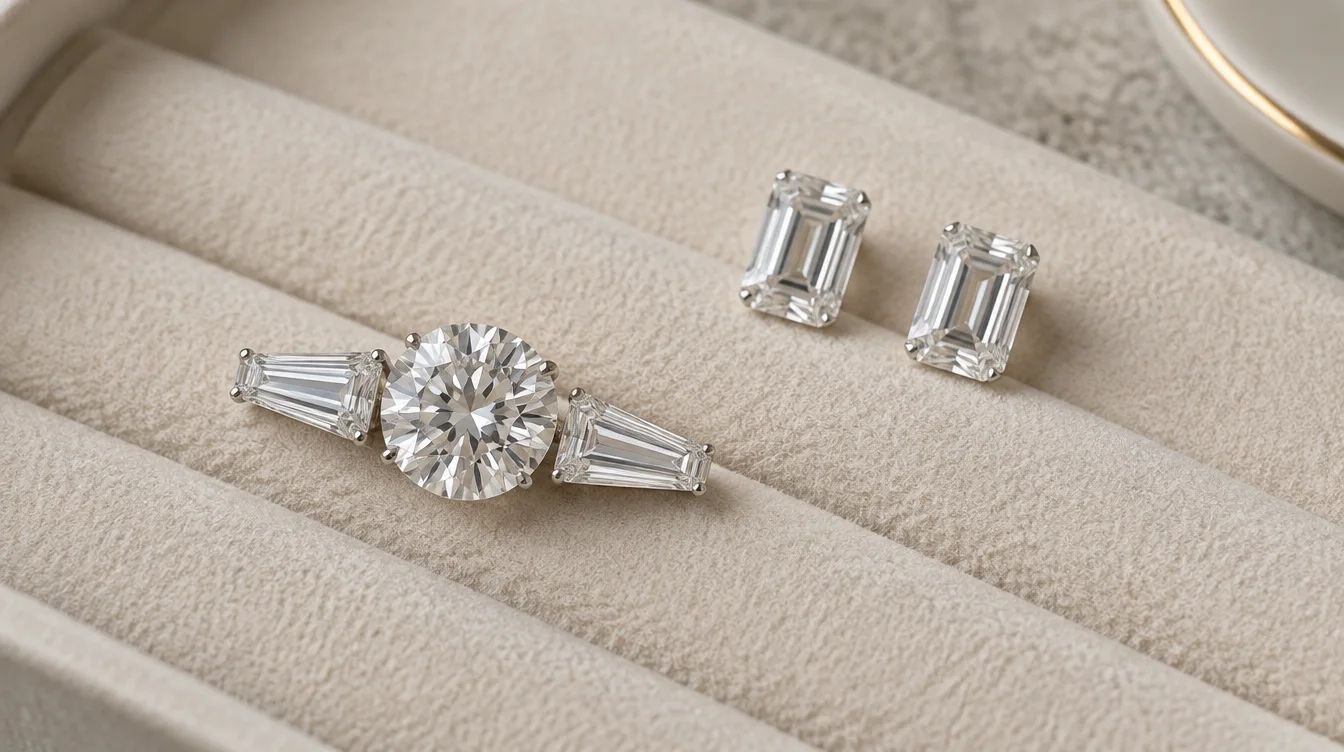
For a center diamond you have already chosen, pick baguettes when you want slim accents that lead the eye toward it. Pick emerald cut sides when you want three distinct stones across the finger. The choice in baguette vs emerald cut diamond side stones comes down to face up size, outline, and how much attention the center should keep. Compare actual pairs beside your diamond before choosing by carat weight.
What changes when you compare baguette vs emerald cut diamond side stones?
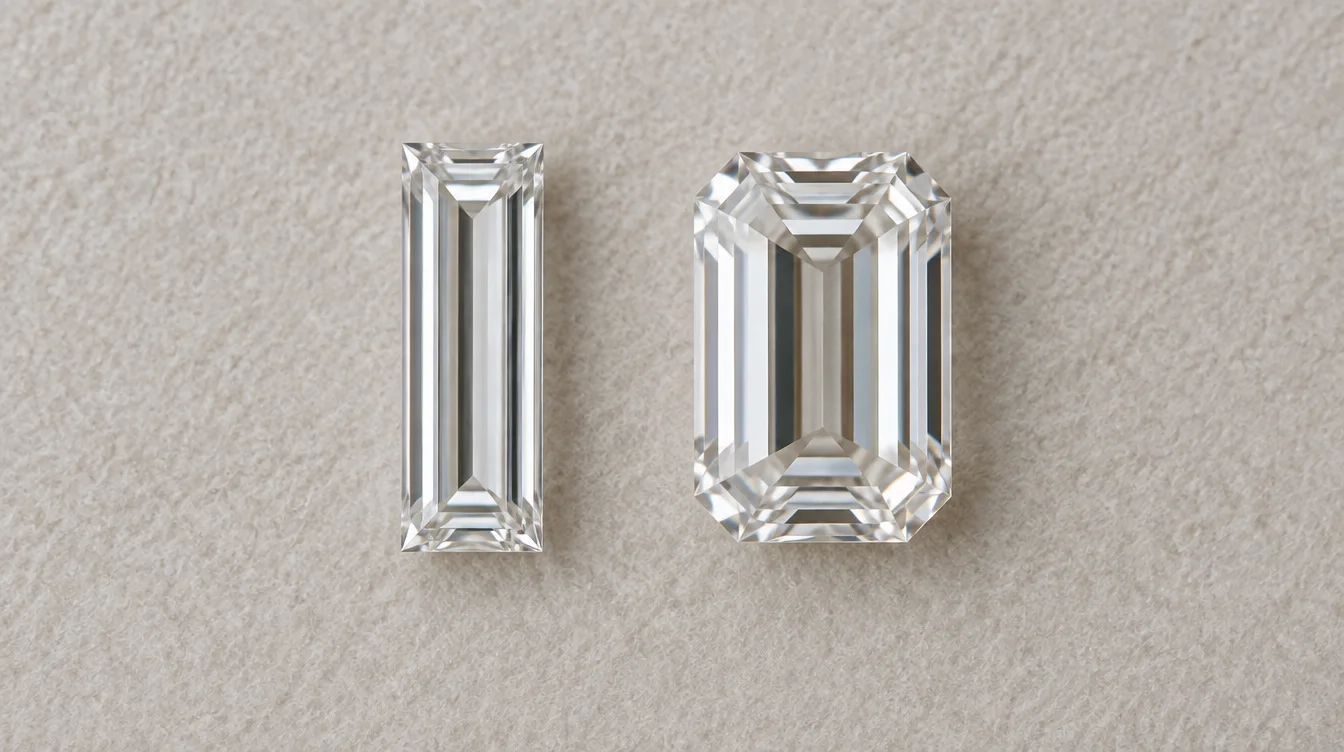
Baguettes frame the center. Emerald cut sides look more like individual diamonds. Both have step cut facets, which give broad flashes rather than the busy sparkle of a round brilliant. A straight baguette is narrow, with square corners. An emerald cut has trimmed corners and usually a wider face. Those shape differences appear in Serendipity Diamonds’ comparison of the two cuts.
Think about where your eye lands first. Slim baguette diamond side stones leave more visual space around an oval, round, or emerald cut center. Wider emerald cut diamond side stones fill that space and give each side its own presence. Neither result is better on its own. The right one supports the ring you want, not a rule about which cuts may sit together.
Shape alone does not settle the choice, though. Two pairs with the same total carat weight can look quite different from above. Start with their face up dimensions.
How should you compare size without relying on carat weight?
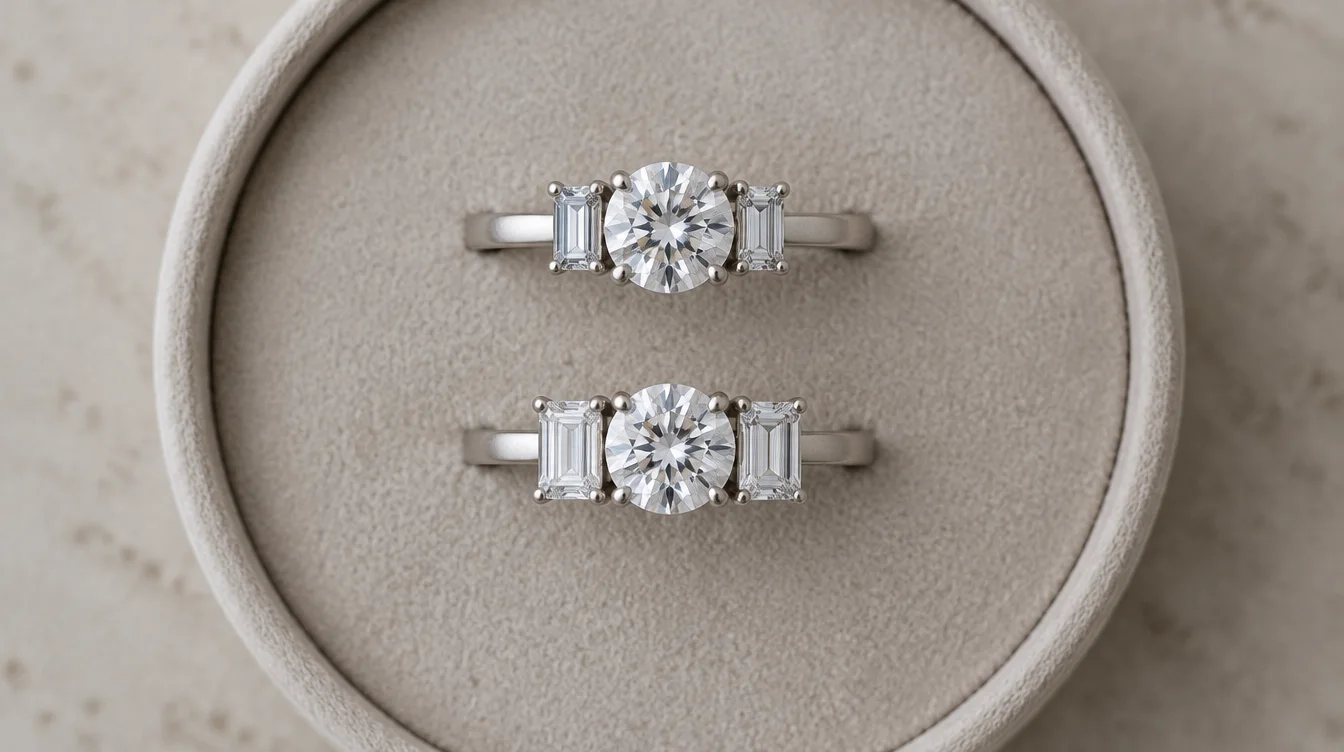
Compare each side stone’s length and width in millimeters. Then view both pairs beside your center diamond. Carat weight measures mass, not how much diamond you see from above. Width helps show whether a side stone will compete with the center. Length shows how far the design reaches toward the band.
Use the center diamond as your fixed point
Ask for a top view mockup at the same scale for each option. Keep the center diamond, gaps, and band width unchanged. That leaves the side stones as the only variable. A loose diamond photo helps, but it cannot show how prongs or bezels affect the finished outline.
Here is an illustrative comparison. Picture a center diamond measuring 8 millimeters across the finger. One side pair measures 3 millimeters wide per stone. Another measures 4 millimeters wide per stone. The second pair adds 2 millimeters of diamond width across the ring. That is before gaps and settings. These are example dimensions, not a recommended three stone ring diamond size ratio.
Judge the outline, not just the spread
A long, narrow baguette can reach toward the shoulders without drawing much focus from the center. A shorter emerald cut side may look stronger because it is wider. In a mockup, cover the center with your finger. Do the sides still look like two small focal points? If so, they carry more visual weight.
Once the scale feels right, look at the corners. They affect both the ring’s style and the way its setting must be made.
When do straight or tapered baguettes make more sense?
Choose straight baguettes for a crisp, even outline. Choose tapered baguettes when you want the diamond line to narrow as it meets the band. With tapered baguette diamond pairs, the broad ends commonly face the center and the narrow ends point outward, as shown in Frank Darling’s side stone examples.
Straight baguettes keep the geometry calm
Straight baguette diamond side stones suit parallel lines and a clear break from the center. Beside a round center, the contrast can look neat and deliberate. Beside a rectangular center, the ring can look more architectural. Check whether the outer ends stop abruptly or flow into the shoulder. The setting can make either choice look intentional.
Tapered baguettes create a softer handoff
Tapered baguette diamond pairs draw the eye inward because each stone widens toward the center. They can work well when your chosen center has a broad edge that needs a gentle link to a narrow band. Yet taper alone will not fix an oversized pair. If the broad ends nearly match the center’s width, the accents may still take over.
Check the pair as mirror images
Both tapered stones should widen and narrow at a similar pace. Ask to see them placed on the correct sides of the center, not lined up in a tray. A slight mismatch becomes easier to spot when their broad ends face each other across the diamond.
If you want the sides to feel more like complete stones than a transition, emerald cuts deserve a closer look.
When are emerald cut side stones the stronger choice?
Emerald cut diamond side stones suit a ring where all three diamonds are easy to see. The center can still hold the focus. Trimmed corners soften the rectangular outline. A broader face gives each side more presence. These stones can echo an emerald cut center. They can also add straight lines beside a round or oval one.
Be careful with the word “matched.” The sides need not share the center diamond’s exact length to width ratio. They do need to look alike beside it. Compare their outlines, apparent widths, corners, and light and dark areas. A pair that matches on a grading report may still look uneven to you.
Emerald cut diamond side stones can show differences that brilliant cuts hide. View the pair in room light and near a window. Rotate the mockup with both stones in place. A separate still image of each stone may hide a mismatch. If one side stays dark while the other lights up, ask to see another pair.
That close look is useful for baguettes too. The next step is to judge both stones as one matched pair, not two separate purchases.
How do you choose a pair that actually looks matched?
Good matched pair diamonds have similar face up size, outline, color appearance, and light pattern when viewed together. The goal is visual balance, not two identical certificate numbers. Ask the jeweler to place the stones on either side of your actual center diamond, or use a scaled image that shows all three from above.
Compare the details in a fixed order
First, check width and length. Then compare the corners and each table, the large top facet. Check color and visible inclusions under the same light. Move the pair together. If one stone keeps drawing your eye for the wrong reason, a small difference on paper may matter in the ring.
Ask what the setting will hide
Prongs can cover a corner. A bezel follows more of the outline. Ask for a mockup with the proposed metal, not just bare diamonds beside the center. Check whether both sides can sit at similar heights and angles. Stones that match on a tray may look uneven if one tilts toward you.
For side stones for three stone engagement rings, a little contrast with the center can be welcome. Unevenness between the left and right sides is harder to ignore. Once the pair passes that test, check how the setting will hold it.
Which setting details should you settle before buying?
Settle the side stone measurements and setting style together. A pair should not be chosen so wide that the jeweler must crowd the center or force the stones into steep angles. Ask to see the gaps, prong positions, and side profile in a rendering or wax model. A top view alone will not tell you how high the sides sit.
Think about daily wear, too. A low setting may feel easier to wear. It still needs room to hold each stone and clear a wedding band if you plan to stack one. Discuss that before ordering the pair. A later setting change may call for different side stone dimensions.
Do not treat a three stone ring diamond size ratio as a fixed buying rule. Center shape, side stone width, gaps, and band shape all change the result. Gabriel & Co. likewise advises balancing side size around the specific center stone, rather than choosing by ratio alone. That brings the decision back to what you can see.
Frequently asked questions
Most final doubts about baguette vs emerald cut diamond side stones come down to sparkle, matching, and scale. These answers can help you review a proposed pair.
Do baguette side stones sparkle less than emerald cut sides?
Both are step cuts, so neither behaves like a round brilliant. Their flashes can look different because the stones differ in shape, size, and facet pattern. Compare the actual pairs under the same light instead of choosing from a cut name.
Can emerald cut sides work with a round center diamond?
Yes. Emerald cut sides add straight lines beside a round center. That contrast becomes part of the design. If you want the round diamond to stay in focus, keep the sides small enough to support it.
How close should the two side diamonds match?
Both stones should look balanced from a normal distance and up close. Similar measurements help. Color, outline, and light pattern also matter. Ask the jeweler to show the stones in their planned positions.
What should I request before approving a side stone pair?
Request each stone’s dimensions in millimeters. Ask for a top view mockup and a side view of the proposed setting. If possible, see the actual stones beside your center diamond. These checks tell you more than total carat weight alone.
Your center diamond is already chosen. Let it lead. Compare a straight or tapered baguette pair with an emerald cut pair at the same mockup scale. See which frame feels right. Before approving the ring, ask to see the actual matched pair in the proposed setting.